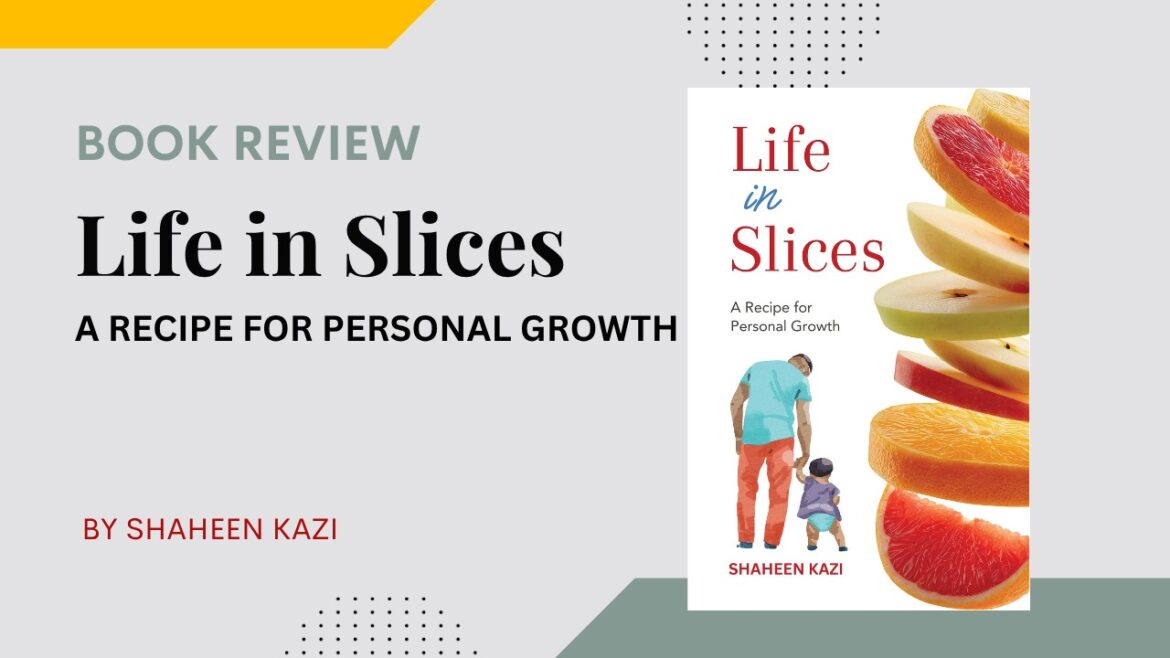
Life in Slices by Shaheen Kazi is the kind of book that does not ask to be rushed. It is better read slowly, a few chapters at a time, because almost every chapter is built around an ordinary thought that turns into a larger reflection. The subtitle, A Recipe for Personal Growth, suits the book well. Kazi treats life as a mixture of experiences—success, failure, family, faith, self-respect, love, ageing, loneliness, gratitude and even death—and shows how each of these adds something to the person we eventually become.
What I liked most about the book is its personal voice. Kazi does not write like someone standing on a stage and giving instructions. She often writes as someone who has struggled, made mistakes, watched people closely, and learned from life in a practical way. In the preface, she speaks about once having no clear career plan and not imagining that she would one day become an author. That background gives the book credibility, because many of the lessons come from a person who has had to build her own sense of purpose rather than simply talk about it.
The structure is also interesting. There are fifty chapters, and the subjects move freely from deeply personal matters to social observations. One chapter may discuss failure, another may talk about women, another about autism, success, self-love, relationships or death. This variety makes the book feel less like a traditional self-help manual and more like a collection of life conversations. You may not agree with every thought, but you are likely to find several chapters that speak directly to something you have experienced.
A chapter that stayed with me was “Failure is the key.” Kazi shares that she failed in Grade Eight and Grade Nine and once feared that poor results would define her future. Later, she connects that experience with rejected manuscripts, disappointing sales and criticism. The message is simple but effective: failure becomes final only when we stop trying. This idea appears again in “The Beauty of Trying,” where she argues that experience comes from taking chances, making mistakes, and learning from the outcome. The chapter sees both success and failure as part of the process of gaining experience. These sections are especially useful for young readers or anyone who has become afraid of starting because they want everything to be perfect from the beginning.
Another strong section is the group of chapters on self-worth, self-love and self-forgiveness. Kazi tries to make self-love practical rather than fashionable. She talks about morning time, journaling, diet, planning, family time, hobbies and reducing useless social-media scrolling. I appreciated this because the book does not reduce self-love to positive quotes. It connects self-respect with daily habits and personal boundaries.
The chapter on self-forgiveness is equally thoughtful. It explains that forgiving yourself does not mean pretending a mistake never happened. Instead, the book discusses responsibility, remorse, restoration and renewal. The idea is to accept what happened, learn from it, repair what can be repaired, and stop allowing guilt to become your permanent identity. This part feels emotionally mature because it balances accountability with compassion.
The book also shows sensitivity when it turns toward family and social subjects. “Autistic Child Is Not Invisible” is written with compassion toward both children and parents. Instead of treating autism as something shameful, the chapter focuses on acceptance, patience, different forms of communication and the importance of recognising each child’s individual progress.
The chapter “She” also left an impression on me. It discusses the many roles women are expected to perform and argues that respect should not depend on whether a woman is someone’s mother, wife, sister or daughter. She deserves dignity first as a human being. These chapters broaden the book beyond personal motivation and give it a stronger social side.
Kazi’s writing style is very direct. She uses questions, short reflections, personal examples, stories and quotations. At times, the writing feels conversational enough that it seems like an older friend is sharing lessons across a table. This simplicity is one of the book’s strengths, especially for readers who do not enjoy complicated philosophical language.
However, there are moments when some ideas are repeated in different forms, particularly around gratitude, positivity, faith and perseverance. Readers who prefer tightly argued nonfiction may feel that a few chapters could have been shorter. At the same time, the repetition also fits the book’s reflective nature because similar lessons appear through very different situations.
I also liked that the book does not avoid difficult subjects. The final chapter on death is a good example. Rather than using death only as something frightening, Kazi treats mortality as a reminder that time is limited, possessions are temporary and our choices matter. The chapter asks readers to consider how they are spending the life available to them. Toward the end, kindness, compassion, love and meaningful actions are given more importance than status or possessions.
Overall, Life in Slices is a warm, sincere and thoughtful book about becoming more aware of how we live. It does not offer a revolutionary theory of personal development, and that is not really its purpose. Its strength lies in reminding us of truths we often know but forget in the rush of daily life.
I would recommend this book to readers who enjoy reflective self-help, personal essays and simple life lessons rooted in everyday experiences. It is especially suitable for those who like to pause after a chapter and think about how the idea applies to their own life. Some slices are sweet, some are painful, some are familiar, but together they create a meaningful picture of growth.
Title: Life In Slices: a recipe for personal growth
Author: Shaheen Kazi
Publisher: Evincepub publishing
Amazon: https://www.amazon.in/Life-Slices-recipe-personal-growth/dp/9373354388
Life In Slices, Life In Slices book review, Life In Slices by Shaheen Kazi, Shaheen Kazi, Shaheen Kazi books, Evincepub Publishing, personal growth book, self-help book, motivational book, personal development, self-improvement, life lessons, reflective self-help, self-love, self-worth, self-forgiveness, overcoming failure, positive thinking, gratitude, emotional growth, mindfulness, personal transformation, inspirational book, women empowerment, family and relationships, autism awareness, dealing with failure,