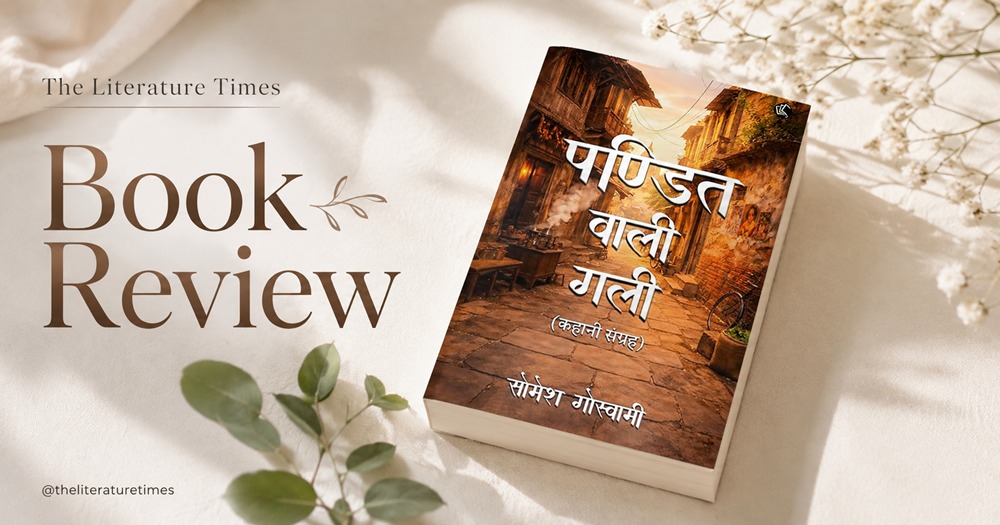
Somesh Goswami’s Pandit Wali Gali is presented as a collection of stories born from observation, emotion and an interest in the ordinary realities of society. The author describes the book as an attempt to bring together social truth and imagination, and that intention gives the collection its clearest identity. Rather than treating fiction only as entertainment, Goswami approaches storytelling as a means of reflecting recognizable human situations: love constrained by social expectations, pride that leads to damaging choices, the continuing burden of dowry, and the everyday decisions through which people reveal their values. The stories are therefore positioned close to lived experience. Their appeal lies not in creating a distant or purely fantastical world, but in encouraging readers to recognize familiar attitudes, tensions and contradictions from the communities around them.
The title story, Pandit Wali Gali, is especially important to the book’s stated purpose. Through the relationship between Madhusudan and Radhika, the story explores how genuine affection can be complicated by the rules, pressures and practical realities of middle-class society. The author’s framing of love as truthful and enduring, yet vulnerable to social boundaries, gives the narrative a broader relevance beyond the lives of its central characters. It suggests that emotional sincerity does not automatically overcome convention, family expectations or circumstance. This tension between personal feeling and social structure is one of the collection’s strongest thematic concerns, because it reflects a conflict that many readers can understand even when their own experiences differ from those of the characters.
A related moral dimension appears in Madhu-Chand Ka Paryay, where a young woman’s pride in her beauty influences decisions that ultimately cause her harm. The stated idea is direct: arrogance can distort judgment, and self-regard without balance can carry consequences. Yet within the larger collection, this theme also complements the author’s interest in examining human choices rather than presenting society as a simple division between right and wrong. The characters, as described by Goswami, are inspired by life around him, and this gives their circumstances a recognizable social foundation. The result is storytelling that aims to create reflection through consequence. Readers are invited not merely to watch events unfold, but to consider the motivations that lead individuals toward difficult outcomes.
The inclusion of dowry as a major social concern gives the book an additional layer of seriousness. Goswami notes that the practice persists across educational and social divisions despite the existence of laws against it. By bringing the issue into fiction, the book participates in a long literary tradition in which social problems are made personal through characters and situations rather than discussed only in abstract terms. This is an important strength of socially engaged storytelling: a problem that can appear statistical or institutional becomes connected to emotion, family pressure, dignity and individual lives. The author does not claim that fiction alone can resolve such realities, but he clearly intends his stories to keep them visible and to encourage readers to think about how harmful practices survive within everyday social structures.
The collection also includes a historical fictional story, expanding the range beyond contemporary social situations. That variety is useful because it prevents the book’s central concern with society from becoming confined to one setting or one kind of conflict. The author’s stated purpose remains consistent throughout: to offer interest and entertainment while also presenting truths about social life in an accessible way. This balance is important for the intended readership. A story collection dealing with social issues can become overly instructional if its message overwhelms its characters and narrative movement. Goswami’s own description suggests an effort to avoid that problem by keeping entertainment, curiosity and realism together rather than treating them as competing goals.
Another notable aspect of Pandit Wali Gali is the author’s relationship with storytelling itself. Somesh Goswami comes from Lalitpur district in Uttar Pradesh and holds a postgraduate degree in Social Work. His interest in stories, however, began much earlier. He credits his mother’s love of literature and storytelling as an important influence, and he describes stories as a source of energy and inspiration. This background helps explain why the book is rooted so firmly in social observation. His academic engagement with social work and his personal literary upbringing meet naturally in a collection concerned with people, relationships and the conditions that shape behaviour. The book is therefore best understood not as detached commentary, but as an attempt to translate public and private social experiences into narrative form.
In terms of writing approach, the book’s stated emphasis is simplicity and relatability. The author wants readers to see reflections of their own lives and society in these stories, and that intention shapes the value of the collection. Such accessibility can be particularly meaningful for readers who prefer fiction with recognizable settings, moral questions and emotional situations rather than heavily experimental forms. The stories appear designed for readers who enjoy Hindi social fiction, family and relationship narratives, and works that combine entertainment with ethical or social reflection. They may also appeal to younger readers and general audiences interested in stories that open conversations about love, pride, tradition, responsibility and social practices.
The strongest promise of Pandit Wali Gali is its commitment to looking at society without separating human feeling from social circumstance. Love is not considered in isolation from convention; personal pride is linked to consequence; dowry is treated not only as a legal issue but as an enduring social reality. This method makes the collection relevant because it places moral and emotional questions within environments readers can recognize. Goswami’s stated humility toward his readers—his request for forgiveness for any shortcomings—also reflects the personal nature of the project. The book emerges as a sincere literary effort by a writer who sees storytelling as both a source of enjoyment and a means of carrying collective feeling into words.
For The Literature Times, Pandit Wali Gali stands out as a socially conscious story collection shaped by observation, cultural familiarity and an earnest desire to connect fiction with real life. Its value lies in its intention to make readers feel entertained while also noticing the structures and attitudes operating around them. For readers drawn to accessible Hindi storytelling with social and moral concerns, the collection offers a thoughtful meeting point between imagination and everyday reality. It invites readers to enter familiar worlds, encounter recognizable dilemmas and perhaps leave with a slightly sharper awareness of how individual choices and social expectations continually shape one another.