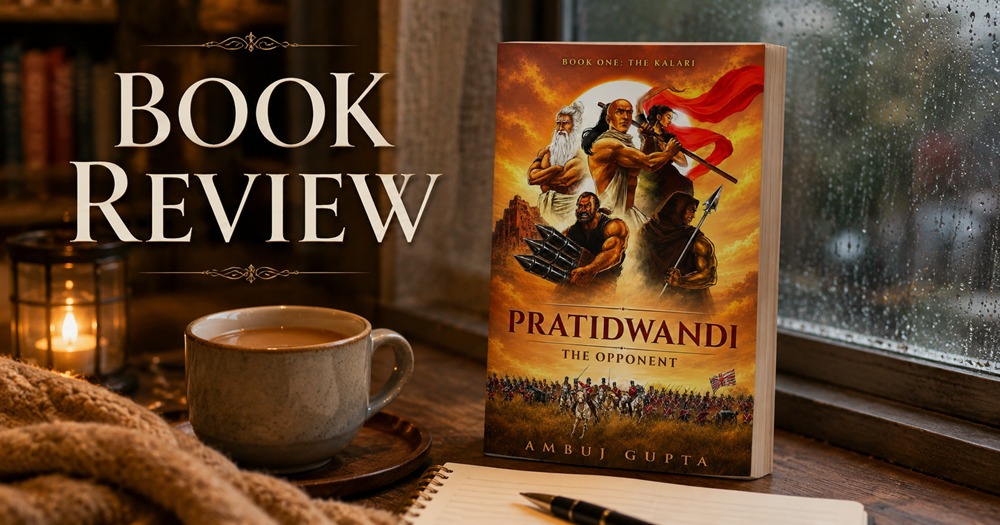
Ambuj Gupta’s Pratidwandi enters a compelling intersection of history, martial arts, adventure and mythology-inspired storytelling, using a fictional universe to revisit a turbulent period in the Indian subcontinent. Set in the years leading to the revolt of 1857, the story follows a band of Indian martial art fighters who choose to resist the oppressive rule of the British East India Company. At the heart of Book One: The Kalari is Sai, a young heir to a legendary family of warriors whose life is abruptly disrupted by the death of his father. What follows is not simply a tale of survival, but the beginning of a larger mystery surrounding family, tradition, resistance and the fate of Kalaripayattu. Gupta’s premise is ambitious in scope, yet grounded in a protagonist whose personal crisis provides an accessible entry point into the larger conflict.
The strongest element of Pratidwandi is its decision to place Indian martial arts at the centre of a narrative of resistance. Kalaripayattu is not presented merely as an ornamental detail within an action-oriented story; from the supplied premise, its survival is directly tied to the central conflict. Sai belongs to a family associated with a legendary warrior tradition, and his father’s death becomes a major setback to that tradition. This gives the martial-art dimension of the novel a cultural and narrative purpose. The story consequently invites readers to look beyond combat itself and consider what happens when a cultural practice, a family legacy and a people’s sense of identity face an external power. That foundation gives Pratidwandi a distinctive thematic identity within adventure fiction.
The historical backdrop also gives the book considerable relevance. By setting the fictional narrative in the period leading to the revolt of 1857 and placing the British East India Company at the centre of the oppressive regime being resisted, Gupta creates a story shaped by questions of power and rebellion. Importantly, the book is described as a fictional universe rather than a conventional historical account, allowing the author to use the historical moment as a framework for imaginative storytelling. This distinction matters. The novel’s value lies not in presenting itself as a factual reconstruction, but in using a recognisable historical context to explore the emotional and dramatic possibilities of resistance. The idea of a people’s revolution shaking a global empire gives the narrative a broad scale, while Sai’s personal circumstances keep that larger struggle connected to an individual journey.
Mystery is another important component of the story’s appeal. Sai begins from a position of profound uncertainty: after receiving news of his father’s death, he is forced to flee his native village, is abducted by dacoits and appears close to losing hope before being saved by a mysterious young boy. The boy’s explanation—that he owes a great debt to Sai’s father—immediately opens several questions. Why would a stranger far from Sai’s home intervene? What was Sai’s father really involved in? And what will become of Kalaripayattu? These unanswered questions provide the narrative with forward momentum. Rather than resolving everything at once, the premise establishes curiosity as a central reading experience. The reader is encouraged to follow Sai not only to discover what happens next, but to understand the hidden connections between his family history, the stranger who saves him and the wider struggle taking shape around him.
Gupta’s storytelling approach also reflects his wider creative background in visual storytelling. As a creator, author and writer-director whose work spans literature, cinema and documentary filmmaking, he brings an interest in cinematic expression to a story that is naturally suited to movement, atmosphere and dramatic confrontation. It would be inappropriate to assume specific cinematic techniques or scenes beyond the information provided, but the premise itself demonstrates an awareness of narrative scale: a young warrior, an endangered tradition, dacoits, a mysterious rescuer and a struggle against an imperial power are elements capable of sustaining a strongly visual adventure. His experience with experimental short films and documentaries also places Pratidwandi within a broader creative practice concerned with exploring different ways of telling stories.
The book’s reader value comes from the way several interests are brought together without reducing the story to a single category. Readers drawn to action and adventure have the martial-art dimension and the danger surrounding Sai. Readers interested in Indian cultural traditions encounter Kalaripayattu as a central part of the narrative conflict. Those who enjoy mystery have the unanswered questions surrounding Sai’s father and his unexpected rescuer, while readers attracted to historical settings can engage with the period leading to 1857 and the presence of the East India Company. The mythology-inspired aspect adds another layer to the fictional universe. This combination makes the book particularly suitable for readers who enjoy genre-crossing narratives and prefer stories in which personal journeys unfold against larger social or political conflicts.
There is also a broader significance in the book’s focus on Indian martial arts. The description identifies Pratidwandi as the first-ever series on Indian Martial Arts, and its creative premise clearly seeks to place this subject at the centre of popular narrative storytelling. Rather than treating Indian martial arts solely as a subject for historical or instructional discussion, Gupta uses them as the foundation for an adventure involving legacy, danger and resistance. That approach can encourage readers to become curious about traditions that may otherwise remain outside their regular reading interests. The cultural dimension is therefore part of the book’s appeal, while the fictional structure gives that dimension a dramatic context.
At its core, Pratidwandi appears to be a story about what people are willing to protect when circumstances threaten to erase or weaken a tradition. Sai’s journey begins with loss, displacement and uncertainty, but the questions surrounding his father and Kalaripayattu suggest that his personal story is inseparable from a larger struggle. The novel’s emphasis on resistance adds another dimension: oppression creates the conditions for people to reconsider their loyalties, identities and responsibilities. Because the narrative is set within a fictional universe, Gupta has room to combine historical inspiration with imaginative possibilities while retaining the emotional stakes of a story about legacy and survival.
Pratidwandi: Book One – The Kalari ultimately presents an intriguing foundation for a series built around Indian martial arts, historical resistance and mystery-driven adventure. Its greatest strength is the convergence of these elements: the cultural importance of Kalaripayattu, the political tension of the period before 1857, the personal loss experienced by Sai and the unanswered questions surrounding his father’s life. Ambuj Gupta’s multidisciplinary background complements this ambitious storytelling project, bringing literature and visual storytelling into the same creative orbit. For readers looking for an Indian adventure narrative with martial arts at its centre, a historical backdrop and mythology-inspired imagination, Pratidwandi offers a distinctive premise and a strong invitation to continue Sai’s journey.