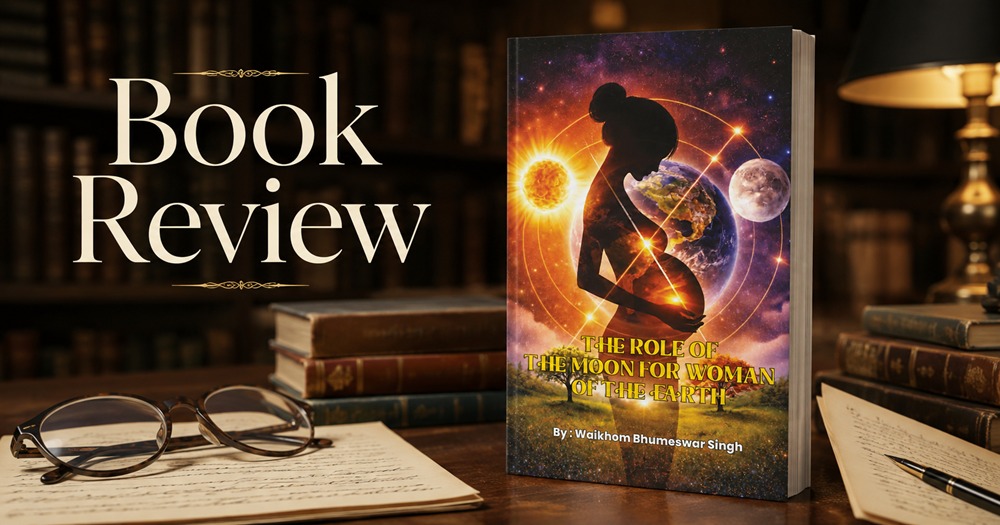
Book Review – The Role of Moon for Woman of the Earth by Waikhom Bhumeswar Singh: A Cosmic Inquiry into Lunar Cycles, Earth, and LifeFrom these recurring patterns, the author develops a larger meditation on growth, decline, transition, and the organization of life. The result is a book that asks readers to look beyond ordinary calendar time and consider whether natural and celestial cycles can offer a deeper framework for understanding existence.
The book’s most distinctive quality is the scale of its inquiry. Singh is not concerned merely with the Moon as an astronomical object or with its familiar cultural symbolism. He positions lunar movement within a much wider interpretation of the Earth’s annual rhythm, giving attention to the way seasonal and light cycles unfold differently across the northern and southern hemispheres. The description of new moon periods as analogous to evening hours and full moon periods as analogous to morning hours suggests that the author is attempting to read the year itself as a larger temporal organism. This conceptual move is unusual and thought-provoking. It turns familiar natural events into components of an interpretive model in which celestial motion, biological life, and time are seen as deeply interconnected.
At the thematic level, The Role of Moon for Woman of the Earth is therefore less a conventional scientific handbook than a philosophical cosmology informed by observation. The book’s ideas invite the reader to think about correspondence: how one cycle may resemble another, how opposite phases may be connected, and how patterns visible in the sky may be reflected in the conditions of life on Earth. The author’s broader body of thought, as described in his biography, is dedicated to bringing ancient wisdom, spiritual inquiry, and scientific understanding into conversation. That intention is clearly present here. Singh appears interested not only in describing physical phenomena but also in asking what those phenomena might mean when considered as part of a universal order.
This approach gives the work both its strength and its challenge. Readers who enjoy speculative philosophy, spiritual cosmology, or unconventional models of time may find the book stimulating because it refuses to remain inside a single disciplinary boundary. It encourages comparison between astronomy and lived experience, and it treats the natural world as a system whose visible patterns may carry intellectual or spiritual significance. At the same time, readers expecting a conventional scientific text may need to adjust their expectations. The ideas presented are best understood as the author’s interpretive framework rather than as a substitute for standard astronomical or biological explanations. A clearer separation between established scientific terminology, personal inference, and philosophical interpretation would make the argument easier to evaluate and could broaden the book’s accessibility to readers from different backgrounds.
The writing approach reflects the density of the subject. Singh works with large concepts in compressed form: rotation and revolution, seasonal transition, hemispheric opposition, lunar phases, cellular growth, and the movement from one stage of a cycle to another. Because these ideas are closely packed, the reader is asked to slow down and consider relationships rather than simply follow a linear narrative. This is not a book designed primarily for casual reading or for readers seeking a straightforward story. Its value lies in contemplation. The language carries the intensity of a writer trying to express a complete worldview, and that seriousness gives the book a distinctive identity. Greater use of definitions, diagrams, illustrative examples, or step-by-step explanation could make the underlying model more immediately understandable, but the conceptual ambition is evident throughout the premise.
Another important dimension is the author’s concern with balance and opposition. North and south, light and darkness, summer and winter, new moon and full moon, ascent and descent are not treated as isolated contrasts; they function as complementary parts of a larger cycle. This idea has clear philosophical resonance. Many traditions have understood life through paired forces and recurring movement, and Singh’s work enters that broad conversation from his own perspective. His model suggests that apparent opposites may be phases of one process rather than independent realities. For readers interested in questions of cosmic order, this can be one of the book’s most rewarding ideas: continuity is not produced by sameness, but by movement between contrasting states.
The author’s background also adds context to the work. Coming from a historically distinguished family of Manipur and drawing upon a heritage connected with the royal household and respected cultural traditions, Singh writes from a position in which ancestry, spirituality, and observation appear to coexist. His stated aim of bridging ancient wisdom with modern understanding helps explain why the book does not fit neatly into one category. The work can be read as part of a personal intellectual project—an effort to formulate a unified vision of humanity’s place within a much larger natural and celestial system. Readers do not need to accept every proposition to engage meaningfully with that project. In fact, the book may be most productive when it stimulates questioning, comparison, and further reading.
In terms of reader value, The Role of Moon for Woman of the Earth will likely appeal most to those who are comfortable with exploratory thought: readers of metaphysics, cosmic philosophy, alternative interpretations of natural cycles, spirituality, or interdisciplinary reflection. It may also interest readers who are curious about how individual thinkers construct comprehensive models from recurring phenomena in nature. Its strongest contribution is not a conventional set of practical lessons but a change of perspective. Singh asks the reader to observe time, seasons, lunar phases, and the Earth’s movement as parts of a connected structure rather than as unrelated facts. That invitation to observe patterns more carefully can itself be valuable, especially in a culture where natural rhythms are often reduced to dates and measurements.
As an editorial work, the book would benefit from especially precise terminology and a more explicit distinction between metaphor, hypothesis, spiritual interpretation, and scientific description. Such refinement would not weaken Singh’s vision; it would help readers understand its internal logic and assess the ideas on their own terms. Nevertheless, the originality of the premise and the author’s commitment to a unified cosmic perspective give the book a clear voice. The Role of Moon for Woman of the Earth is a serious, unconventional meditation on lunar and terrestrial cycles, written for readers willing to engage patiently with a worldview that crosses the boundaries of astronomy, philosophy, and spirituality. It is ultimately a book about relationship—between Moon and Earth, light and darkness, seasonal change and living processes, and humanity and the larger order in which it exists. For readers drawn to such questions, Singh’s work offers a distinctive starting point for reflection.