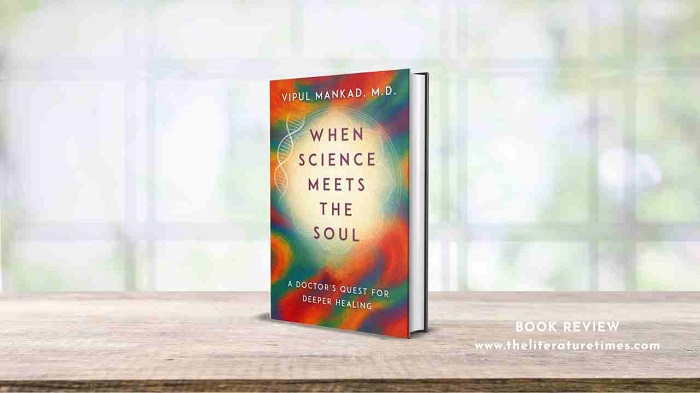
When Science Meets the Soul is a rare kind of book—one that combines the emotional sincerity of a memoir, the intellectual rigor of scientific inquiry, and the quiet power of spiritual reflection. Dr. Vipul Mankad, a physician, scientist, immigrant, and lifelong seeker, invites readers on a journey that is as intimate as it is expansive. Through his life story, he attempts to answer one of humanity’s oldest and most elusive questions: Who am I? The core strength of the book lies in how seamlessly Mankad weaves together history, culture, science, and philosophy while grounding everything in personal experience. Instead of preaching or prescribing, he opens windows into his life—his childhood in post-colonial India, the challenges of migration, the cultural dislocation of arriving in the United States in 1968, and his decades-long service as a pediatrician. Through each stage, he reflects on how identity is shaped by family, genetics, culture, belief systems, and lived experiences. His writing is reflective without being heavy, and informative without slipping into academic detachment.
The memoir begins with his early life in a newly independent India—a nation still recovering from colonial trauma, economic deprivation, and social upheaval. With vivid descriptions, he brings back memories of simpler times: classrooms where children sat on the floor, radio programs listened to by entire neighborhoods, and a society struggling to rebuild itself after the horrors of Partition. Mankad does not shy away from discussing the inequalities, struggles, and societal constraints of the time, yet he also captures the optimism and resilience that shaped his generation.
One of the most compelling sections of the book is his recounting of the journey from India to the United States. The cultural shock he experiences—whether from unfamiliar food, differing social norms, or the newfound diversity of people he encounters—serves not only as an entertaining narrative but also as the foundation of his lifelong introspection. Here, he begins questioning the assumptions he grew up with, especially around religious identity, social expectations, and moral duty. Through these questions, readers are reminded that migration is not just a geographical transition but a psychological and emotional transformation.
The second part of the book turns toward the sciences—archaeology, genetics, linguistics, population studies—and explores how these fields contribute to our understanding of identity. Mankad’s ability to distill complex scientific concepts into simple, engaging language is impressive. He presents the story of human evolution and migration with a refreshing objectivity, using his own family’s genomic profile as an example of how interconnected humanity truly is. This section encourages readers to look beyond superficial labels of caste, race, nationality, and religion, revealing how these identities are shaped by centuries of movement, adaptation, and cultural exchange.
The third part of the book moves into spirituality, philosophy, and the study of consciousness. Here, Mankad shines as both a scientist and a seeker. Rather than opposing science and spirituality, he sees them as complementary perspectives that explore different dimensions of the same truth. His reflections on Hindu philosophy—Bhakti, Karma, Jnana, and Dhyana Yoga—are deeply rooted in personal practice rather than dogma. He writes about meditation, self-reflection, and the pursuit of equanimity with sincerity and clarity, making ancient ideas accessible to contemporary readers. His discussion on consciousness is particularly thought-provoking, inviting readers to explore the idea that our true identity lies beyond the body-mind machinery.
What makes this book especially impactful is its emotional honesty. Mankad writes openly about his fears, dilemmas, and internal conflicts—the pressure to fulfill familial expectations, the guilt of leaving his parents behind, the challenge of maintaining cultural roots in a foreign land, and the struggle to reconcile faith with scientific rationalism. His vulnerability allows readers to connect with him on a human level, making the philosophical portions feel grounded rather than abstract.
Another admirable element is his humility. Despite being a highly accomplished physician and academic, he never positions himself as an authority but rather as a fellow traveler. He acknowledges the limits of his knowledge, encourages readers to question everything—including his own views—and emphasizes the importance of personal exploration. The self-assessment tools and reflective questions in each chapter are not gimmicks; they genuinely help readers engage with their own search for meaning.
The book’s narrative arc ultimately leads to a simple yet profound message: to live a good life, one must understand the self—not the externally defined self shaped by labels and roles, but the inner self rooted in clarity, compassion, and consciousness. Mankad argues that by detaching from imposed identities and embracing our universal nature, we can achieve mental balance even in a chaotic world.
When Science Meets the Soul is not just a memoir. It is a guidebook for self-understanding, a bridge between ancient wisdom and modern inquiry, and a heartfelt offering from a man who has spent his life caring for others. Readers from every background—scientists, spiritual seekers, immigrants, students of philosophy, or anyone navigating the complexities of identity—will find resonance in these pages. It is a book that invites reflection, encourages openness, and ultimately reminds us that the search for truth is both a personal and universal journey.
Amazon Link : https://www.amazon.in/dp/9370025375