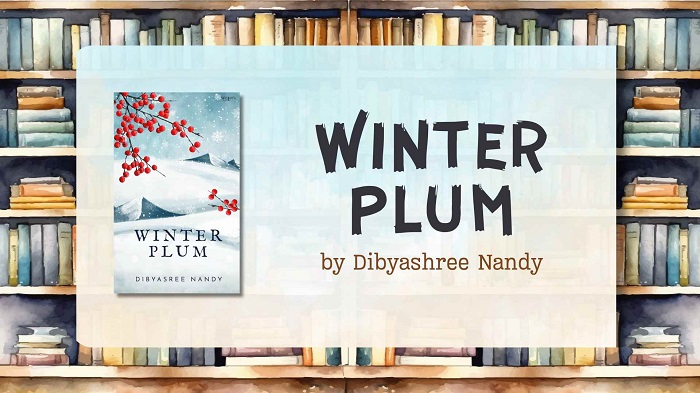
Dibyashree Nandy’s Winter Plum is not just another short story collection; it is an artistic exploration of the human psyche, a literary bouquet where each story is a different flower, ordinary in its appearance, yet brimming with fragrance and meaning once one leans closer. The book, which arrives in paperback on 19 February 2025, is a dense yet delicate collection that takes readers through the many shades of human emotion: love, betrayal, weakness, resilience, loss, and the sometimes quiet, sometimes turbulent search for identity. It is this ability to transform everyday, innocent prompts into deeply reflective narratives that sets Nandy apart as a storyteller.
At the heart of this anthology lies the novella Winter Plum, the work after which the collection is named. This story alone could have stood independently as a powerful piece of contemporary literature, yet in this anthology it serves as the anchor around which the other stories revolve. Winter Plum tells the tale of a transgender woman grappling with identity, existence, and acceptance. To cope with her struggles, she imagines a brother and sister fragmented pieces of herself that embody her unspoken fears and unexpressed desires. The story finds resonance in its fairy-tale-like ending, which makes use of allusions to the Russian ballet Swan Lake. The elegance of this reference provides a poetic layer to the narrative, allowing readers to glimpse not just the protagonist’s pain but also her capacity for beauty, imagination, and survival.
While Winter Plum is undoubtedly the soul of the book, the richness of this collection lies in its variety. The stories arise from a challenge posed by the publisher, Writer’s Pocket, where the author was tasked to pick from fifty prompts and create forty-five different stories in the span of a month and a half. This constraint could have easily led to forced narratives or repetitive tones, but Nandy uses the challenge as a canvas to experiment, capturing diverse shades of humanity. The prompts themselves, ranging from jealousy, lies, and imperfection to sunshine, rain, and coffee, provide an intriguing framework that Nandy elevates into intricate, layered stories.
For instance, the story Gandhari, written under the prompt “Darkness,” reimagines the Mahabharata from the perspective of the blindfolded queen. In doing so, Nandy not only reclaims a mythological voice that has often been overlooked but also offers readers a poignant commentary on blindness both literal and metaphorical in relationships, politics, and human choices. Similarly, The War Photographer inspired by the prompt “Photograph” brings out the poignancy of memory, conflict, and the frozen weight of moments captured on film. With The Confession of a Patriot (based on the prompt “Unsent texts”), the author taps into a modern dilemma what is left unsaid and how silence itself becomes a testimony. Each story bears the mark of precision, imagination, and a sensitivity to human fragility.
The breadth of stories is astonishing. Some are whimsical, like The Theft of the Harlequin Statue based on birthdays, while others are devastating in their quietness, such as Lucy, which arises from the theme “I miss you.” The author’s versatility ensures that the reader is never lulled into predictability; each page presents a new emotional landscape, one that could be filled with humor, tragedy, or unsettling revelations. There is also a wonderful play of contrasts: the innocence of childhood evoked in Scarlet Equations sits side by side with the dark intrigue of Murder in the Dining Car. The fantastical threads in The Dreaming Concubine balance the raw realism of Wheelchair and Seed.
What makes Nandy’s work especially compelling is her ability to handle sensitive subjects with grace and authenticity. In Winter Plum, the transgender protagonist is not treated as a trope but as a fully fleshed human being with inner conflicts and layered desires. This reflects the author’s larger intent: to probe the core of human nature in its best and worst forms. The stories are not meant to provide easy answers but rather to make readers pause, reflect, and perhaps confront parts of themselves they usually keep hidden.
Another striking feature of the book is its structure and rhythm. Though the stories are born from rigid prompts, there is a natural flow in the way they are arranged, almost as if each is in conversation with the next. Themes of love, betrayal, death, and longing weave seamlessly into one another, ensuring the collection is not just a compilation of disjointed tales but a coherent artistic expression. Nandy’s prose, too, is fluid lyrical at times, sharply observant at others. She shifts between styles effortlessly, whether she is reconstructing an epic through Gandhari’s eyes or crafting a modern love story around glow-worms.
The book also stands as a testament to the endurance and creativity of the author herself. Writing forty-five distinct stories within such a short time frame is a feat in itself, but more impressive is the consistency of quality across them. While some tales resonate more deeply than others, as is inevitable in any large anthology, the reader never encounters a story that feels hollow or hastily executed. Even the lightest or shortest pieces carry a spark of thoughtfulness.
Dibyashree Nandy, with her already prolific body of work including titles like The Labyrinth of Silent Voices: Epistles from the Mahabharata and Fireflies Beneath the Misty Moon, once again proves her literary agility. She thrives on experimentation, moving between poetry, epistles, and prose with equal ease. In Winter Plum, she has not only embraced the challenge of constraints but turned it into an opportunity to showcase the breadth of her imagination.
Ultimately, Winter Plum is more than a collection of stories, it is a mirror held up to human life, with all its flaws, contradictions, and moments of fleeting grace. It invites readers to recognize themselves in characters who are jealous, loving, broken, hopeful, or lost. It asks us to acknowledge that beauty can be found even in the darkest corners, just as a plum blossoms in the chill of winter. For anyone who values literature that both unsettles and uplifts, that confronts while also consoling, Winter Plum is a must-read.