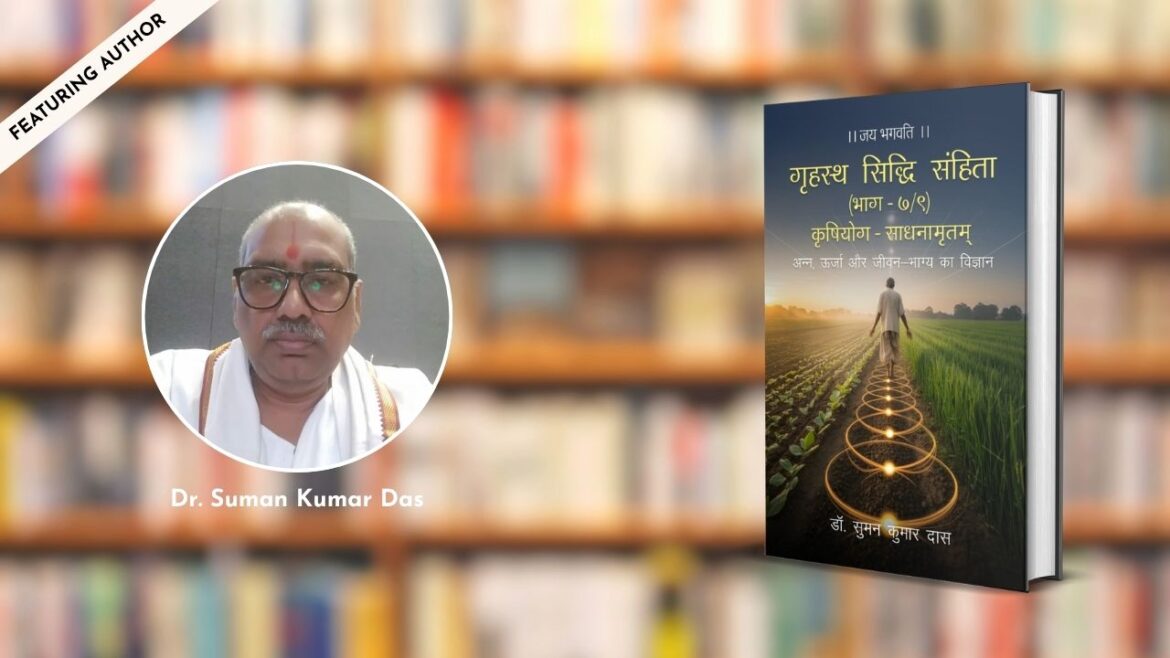
In an era marked by environmental degradation, industrial agriculture, and growing disconnection between humanity and nature, Dr. Suman Kumar Das stands out as a visionary thinker who is redefining the relationship between spirituality, agriculture, and human well-being. An author, researcher, spiritual teacher, agriculturist, and founder of Lalita Divyashram, he has dedicated his life to demonstrating that the future of civilization lies not in choosing between science and spirituality, but in harmonizing the two.
Known spiritually as Swami Sumananand Nath, Dr. Das brings together a rare combination of academic rigor, entrepreneurial experience, and decades of spiritual practice. His life journey reflects a continuous search for meaningful solutions to some of humanity’s most pressing challenges—how to live sustainably, cultivate inner peace, restore ecological balance, and create prosperous communities rooted in wisdom rather than exploitation.
Born in Bihar, India, Dr. Das pursued higher studies in Philosophy and Russian Linguistics before earning a Ph.D. in Linguistics from the prestigious Pushkin State Russian Language Institute. His academic background, coupled with extensive international exposure through business and educational ventures, enabled him to view ancient Indian knowledge systems through a contemporary and scientific lens. While many scholars remain confined to theory and many spiritual teachers remain detached from practical realities, Dr. Das has consistently sought to bridge these worlds.
After achieving professional success across multiple countries, he made a conscious decision to devote his life to exploring the practical applications of Sanatan wisdom in modern society. This transformation led to the establishment of Lalita Divyashram near Khajuraho, a unique center dedicated to spiritual practice, consciousness studies, sustainable agriculture, ecological restoration, and rural development. The ashram has become a living laboratory where ancient principles are tested, refined, and integrated with modern scientific understanding.
Among his most significant contributions is the development of the concept of “Krishiyoga,” a holistic approach that views agriculture as much more than the production of food. For Dr. Das, farming is a sacred process that nurtures not only crops but also consciousness, culture, and community. This philosophy finds its most comprehensive expression in his book Krishiyoga Sadhanamritam, the seventh volume of the Grihastha Siddhi Samhita series.
In this groundbreaking work, Dr. Das challenges the prevailing notion that agriculture is merely an economic activity driven by profit and productivity. Instead, he revives the ancient Rishi-Krishi tradition, which regarded cultivation as a sacred partnership between human beings and nature. The book presents a compelling synthesis of regenerative agriculture, biodiversity, soil science, ecological sustainability, mantra practices, and Vedic philosophy.
What makes Dr. Das’s perspective particularly relevant today is his emphasis on interconnectedness. He argues that soil health, human health, environmental sustainability, and spiritual well-being cannot be separated. According to his vision, food is not simply a commodity; it is condensed life-force, carrying the energies of the soil, farmer, environment, and collective consciousness. This understanding transforms agriculture from a commercial enterprise into a sacred responsibility.
At Lalita Divyashram, Dr. Das has spent years developing innovative models such as Trigunatmak Krishi, Gau Krishi Vanijyam, Panchatattva Agriculture, and Mantra-Based Farming. These approaches integrate livestock systems, tree-based agriculture, biodiversity conservation, water management, and spiritual practices into a unified ecological framework. His experiments demonstrate that sustainable agriculture is not only environmentally necessary but also economically viable and spiritually enriching.
Beyond agriculture, Dr. Das is widely recognized for his pioneering work in consciousness studies and mantra-based transformation. As the founder of the 41-Days Mantra Yoga Movement, he has guided thousands of individuals through structured programs that combine meditation, self-observation, mantra practice, and disciplined living. His teachings emphasize that spirituality should not be confined to rituals or isolated retreats but should actively shape daily life, family relationships, education, health, and professional endeavors.
This holistic philosophy is reflected throughout his extensive body of work. Whether writing about spirituality, education, health, agriculture, household dharma, or consciousness, Dr. Das consistently emphasizes integration rather than fragmentation. He believes that modern society’s greatest challenge is not a lack of knowledge but a lack of harmony between different dimensions of human existence.
One of the defining features of his work is its practicality. While deeply rooted in ancient traditions, his teachings avoid dogmatism and encourage experimentation, observation, and direct experience. He often reminds his students and readers that wisdom must be lived rather than merely studied. His guiding principle, “What is lived deeply should be written honestly, and what is written should be capable of transforming life,” reflects this commitment to authenticity.
As environmental concerns intensify and societies search for sustainable models of development, Dr. Suman Kumar Das offers a compelling alternative vision. He proposes that genuine progress cannot be measured solely through economic growth or technological advancement. Instead, it must include ecological balance, cultural continuity, spiritual awareness, and human flourishing.
Through his books, research, field projects, and educational initiatives, he continues to inspire farmers, householders, scholars, policymakers, and spiritual seekers alike. His work serves as a reminder that the solutions to many modern challenges may lie not in abandoning ancient wisdom, but in rediscovering and reinterpreting it for contemporary needs.
In an increasingly fragmented world, Dr. Suman Kumar Das stands as a bridge-builder—connecting science with spirituality, agriculture with consciousness, and tradition with innovation. His vision points toward a future where humanity lives not in conflict with nature, but in conscious partnership with it, cultivating not only crops and prosperity, but also wisdom, harmony, and a deeper understanding of life itself.