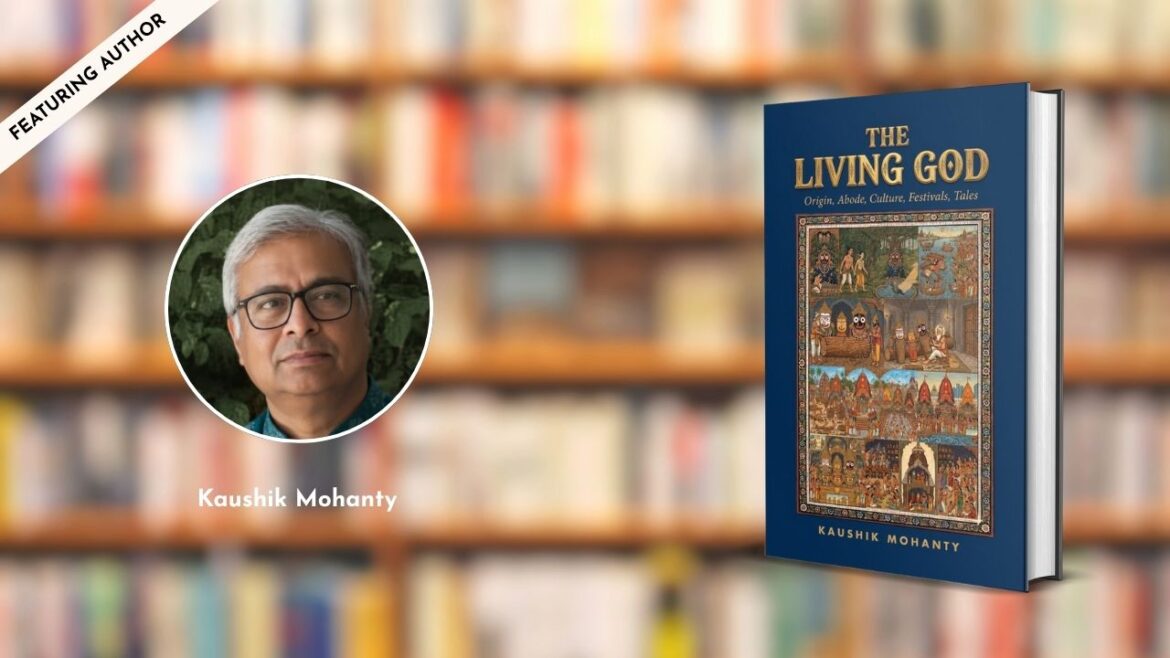
Some writers are drawn to stories; others are drawn to mysteries. For Kaushik Mohanty, the journey has always been a pursuit of both. An engineer by training, an MBA by qualification, and a storyteller by passion, he represents a rare blend of analytical thinking and creative imagination. His work reflects an enduring curiosity about the world, a respect for history and culture, and a deep fascination with the spiritual traditions that continue to shape human lives across generations.
Kaushik’s literary journey is rooted in observation and inquiry. Coming from a professional background that values precision, structure, and logic, he developed an appreciation for understanding systems and uncovering the deeper patterns behind seemingly ordinary realities. Yet beyond numbers, processes, and business strategies, he found himself increasingly captivated by stories—stories of people, places, traditions, and beliefs that carry meaning beyond the visible surface.
Before turning his attention to spiritual and cultural narratives, Kaushik explored fiction through short story collections and micro-fiction. These early works allowed him to develop his voice as a writer and storyteller. His ability to capture emotions, create atmosphere, and communicate complex ideas in an accessible manner earned him recognition among readers who appreciated both the simplicity and depth of his writing. However, as his literary interests evolved, he found himself drawn toward a subject that has inspired countless scholars, devotees, historians, and seekers for centuries: Lord Jagannath.
For many people, Lord Jagannath is a revered deity. For others, He is a symbol of Odisha’s cultural identity. Yet for Kaushik Mohanty, Lord Jagannath represents something even more profound—an infinite mystery that cannot be fully explained, defined, or contained. This understanding became the foundation of his book, The Living God, a work that seeks not to claim authority over the subject but to humbly explore its many dimensions.
What distinguishes Kaushik’s approach is his recognition of the limits of human understanding. He firmly believes that the finite mind cannot fully comprehend the Infinite. In his view, any claim of complete knowledge about Lord Jagannath would be inherently flawed, because the Divine transcends the boundaries of language, logic, and interpretation. Rather than presenting himself as an ultimate authority, he positions himself as a student, researcher, and guide who seeks to bring together insights from scholars, saints, traditions, and historical sources.
This humility is perhaps one of the defining characteristics of his work. In an era often dominated by certainty and quick conclusions, Kaushik embraces complexity and mystery. He understands that spiritual traditions endure not because every question has been answered, but because they continue to inspire reflection, wonder, and exploration. His writing invites readers to engage with the subject not as passive recipients of information but as participants in a living cultural and spiritual conversation.
The inspiration behind The Living God emerged from his desire to bridge generations. He observed that many younger readers, despite growing up in a rapidly modernizing world, remain curious about their cultural roots. However, they often struggle to access traditional knowledge in a format that feels relevant and approachable. Ancient texts, oral traditions, and scholarly works contain immense wisdom, but their language and presentation can sometimes create barriers for contemporary audiences.
Recognizing this challenge, Kaushik set out to create a guide that would serve as a bridge between the past and the present. Through clear explanations, engaging storytelling, and thoughtful synthesis, he presents the world of Lord Jagannath in a way that remains faithful to tradition while being accessible to modern readers. His work explores not only the deity’s origin and sacred abode but also the culture, festivals, rituals, and legends that have evolved around one of India’s most unique spiritual traditions.
His fascination with Lord Jagannath extends beyond theology. He is deeply interested in the cultural ecosystem that surrounds the deity—the architecture of the sacred city of Puri, the symbolism embedded in rituals, the social values reflected in traditions, and the extraordinary resilience of a faith that has survived centuries of political and social change. Through his writing, he reveals how the Jagannath tradition serves as a remarkable example of inclusivity, continuity, and spiritual accessibility.
As a storyteller, Kaushik understands that facts alone do not create lasting connections. Stories do. Whether describing ancient legends, historical events, or living traditions, he brings warmth and humanity to his narratives. His writing allows readers to see not only the grandeur of the Jagannath tradition but also its deeply personal dimensions. The Divine, in his work, is never distant or abstract. Instead, Lord Jagannath emerges as a living presence woven into the daily lives, hopes, celebrations, and struggles of countless devotees.
Today, Kaushik Mohanty continues to explore the intersection of culture, spirituality, and storytelling. His work reflects a commitment to preserving heritage while making it meaningful for future generations. He believes that understanding cultural traditions is not merely an academic exercise but a way of strengthening identity, fostering connection, and discovering deeper purpose.
Through The Living God, he offers readers more than information; he offers an invitation—to question, to learn, to wonder, and to experience the enduring mystery of a tradition that has captivated hearts for centuries. In doing so, Kaushik Mohanty establishes himself not only as a writer but also as a thoughtful interpreter of heritage, helping modern readers navigate the timeless landscape where faith, culture, and humanity meet.