In every great epic, there are characters who shape destiny with their choices—and then there are those whose silence carries the weight of an entire kingdom. Gandhari, the queen of Hastinapura, is one such presence in the Mahabharata. For centuries, she has been remembered as the woman who chose to blindfold herself out of loyalty to her blind husband, Dhritarashtra, and as the grieving mother of the Kauravas. But what if a single choice—her blindfold—had been different? What if she had chosen sight over sacrifice? What would the Mahabharata look like if Gandhari had allowed herself to see?
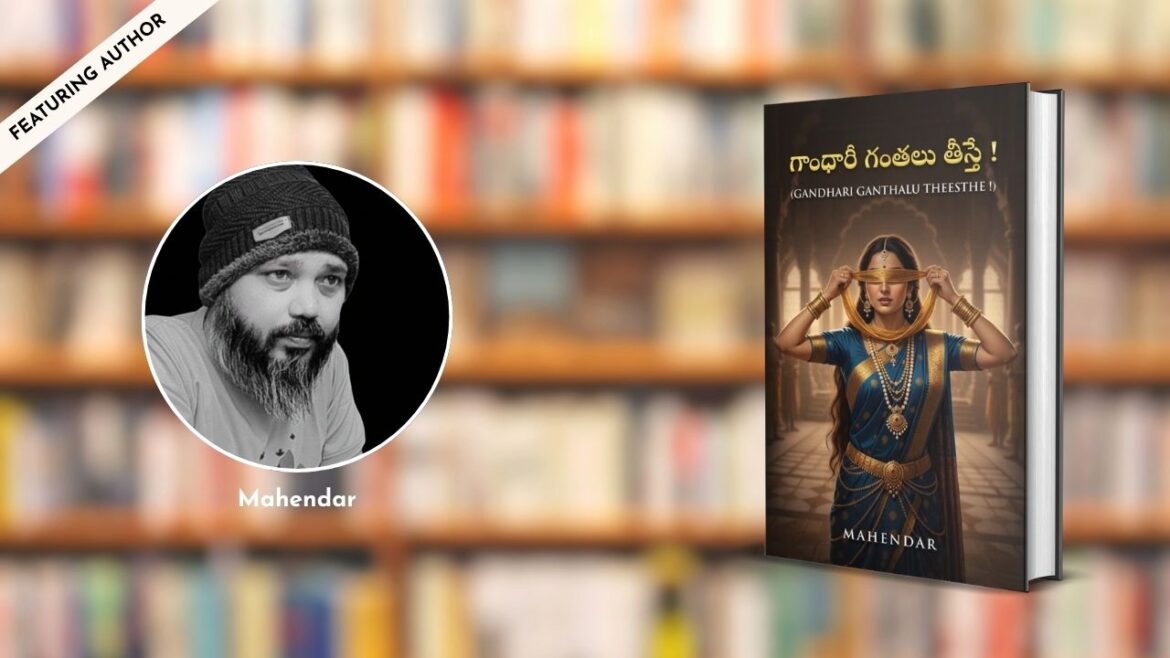
These are the questions that ignite the imagination behind Gandhari Ganthalu Theesthe! a bold and thought-provoking book by Mahendar, a passionate reader and a first-time author from Hyderabad. At its core, this book is not just a retelling of an ancient narrative but an exploration of an alternate universe—one where Gandhari removes the knots of her blindfold and chooses clarity over self-imposed darkness.
The Mahabharata is a grand tapestry woven with fate, dharma, love, war, pride, and grief. Within this vast story, Gandhari is often seen as stoic and silent—enduring her husband’s blindness, raising a hundred sons, witnessing their downfall, and living with the bitterness of fate. But Mahendar invites readers to step into an unexplored emotional world: what if Gandhari regretted blindfolding herself? What if she had questions, doubts, and desires she never expressed? And most importantly, how different would history be if she had kept her eyes open?
In imagining this alternate path, the book casts new light on Gandhari as a woman, a queen, a mother, and a human being. Instead of being defined by sacrifice alone, she becomes a thinker—a person capable of introspection, intervention, and influence. The book raises compelling possibilities: Would the Kauravas have grown differently under her direct supervision? Would her presence have softened Dhritarashtra’s decisions or tempered Duryodhana’s arrogance? Could her sight have changed the political fabric of Hastinapura? Could the war of Kurukshetra itself have been avoided?
Through these questions, Mahendar transforms mythology into a space for reflection, showing how a single personal choice can change the destiny of an entire empire. The narrative doesn’t try to alter the epic’s grandeur; instead, it opens a window into the heart of a woman whose story has long been overshadowed by the actions of the men around her. Readers are invited to imagine a Gandhari who watches, thinks, guides, and possibly even corrects the tragic trajectory her sons eventually follow.
Behind this powerful reimagining stands Mahendar himself—a man whose relationship with books has shaped the way he experiences the world. For nearly two decades, he has been a devoted reader, consuming at least 100 pages a day with unwavering consistency. His love for stories, characters, emotions, and possibilities forms the backbone of his writing journey. Although Gandhari Ganthalu Theesthe! is his first book, his familiarity with literature gives him the courage to experiment, to ask questions often left unasked, and to challenge the boundaries of traditional narratives.
Mahendar readily shares that he has no formal training as an author. Instead, he approaches writing with sincerity and honesty, treating the “thought” itself as a powerful weapon. In his own words, he simply allowed an idea to take shape, trusting his instinct more than conventional structures. His humility reflects in his willingness to accept feedback and correct mistakes wholeheartedly, making his journey not just creative but deeply human. This authenticity shines through every page of his work.
What sets this book apart is the author’s personal connection to his subject. Gandhari’s decision to blindfold herself has always been seen as a gesture of loyalty and sacrifice. Yet, Mahendar looks beyond the symbolic act and wonders what it truly meant for her as a woman who willingly embraced darkness. In doing so, he gives voice to the emotional debates she may have carried deep within her—conflicts that many women even today may relate to: the burden of duty, the cost of silence, the price of sacrifice, and the longing for agency.
The book resonates because it speaks to a universal truth—that every life, whether royal or ordinary, contains hidden knots of regret, reflection, and unanswered questions. Gandhari’s blindfold becomes a metaphor for every sacrifice made without understanding its long-term consequences. And when the author imagines her removing it, he symbolically speaks to anyone who has ever wished to reclaim their clarity, their choices, and their voice.
With Gandhari Ganthalu Theesthe!, Mahendar contributes something meaningful to contemporary mythological literature. He brings freshness to a timeless epic, not by rewriting it, but by rethinking it. He opens up a conversation around characters who have been admired for centuries, encouraging readers to revisit them with curiosity and empathy.
As his first published work, this book marks the beginning of Mahendar’s literary journey—one built on imagination, dedication, and a profound respect for storytelling. His love for books has turned into an act of creation, and through this debut, he steps into the world not just as a reader but as a writer with a distinct voice and a bold question.
In exploring what Gandhari might have seen, felt, or changed, he offers readers not only a new perspective on an ancient tale, but also an invitation to untie the knots within themselves—to see, to think, and to ask the questions that shape destiny.