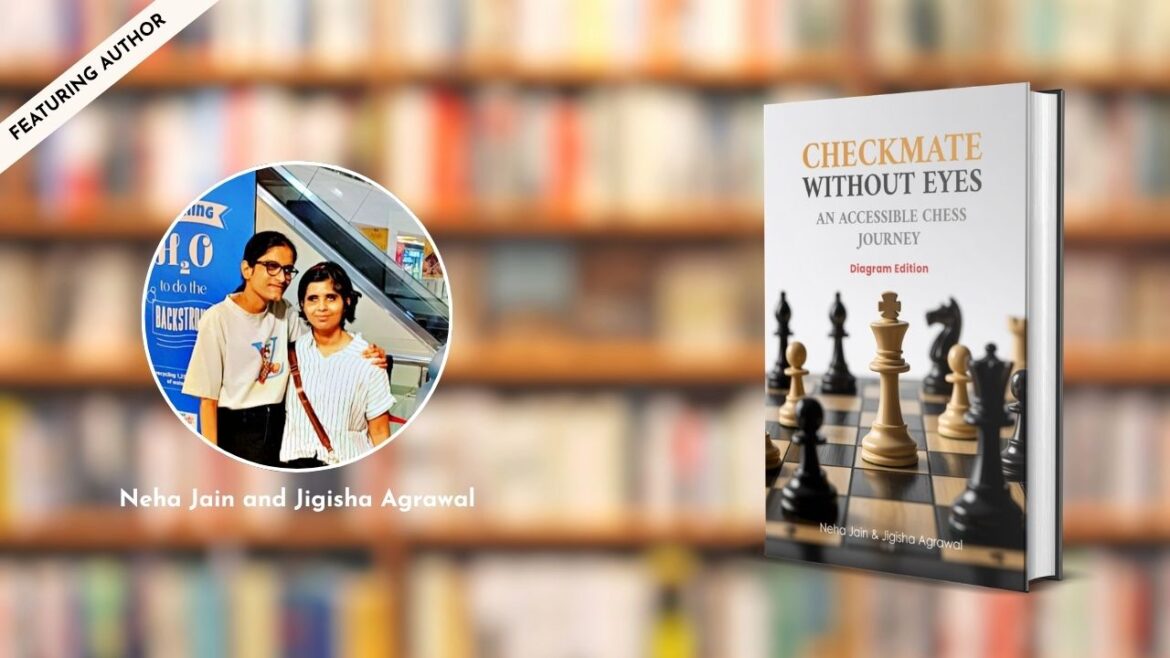
In a game as intellectually rich and universally admired as chess, accessibility has often been an afterthought. The board, the pieces, the patterns—all are traditionally taught through visual familiarity, leaving many learners dependent on a single mode of understanding. Checkmate Without Eyes: An Accessible Chess Journey [Diagram Edition] by Neha Jain and Jigisha Agrawal challenges that limitation with quiet confidence. It is not just a guide to chess; it is a thoughtful reimagining of how the game can be taught, learned, and experienced by players across different abilities and learning styles.
This edition carries forward the vision established in its earlier textual counterpart but expands its reach through the inclusion of diagrams, notation, and detailed explanations. The result is a book that speaks to everyone—sighted players, visually impaired learners, beginners, and even coaches looking for structured teaching methods. By combining visual representation with descriptive clarity, the authors create a learning environment that is both inclusive and comprehensive. It is this balance that makes the book truly universal.
At its heart, the book is designed not merely to teach moves but to build understanding. Chess, after all, is not a game of isolated actions—it is a continuous flow of ideas, anticipation, and decision-making. The diagrams included in this edition act as anchors for these ideas, helping readers visualize positions, understand piece coordination, and grasp strategies that might otherwise seem abstract. At the same time, the accompanying explanations ensure that no learner is left behind, reinforcing concepts through clear, structured guidance.
What makes this work particularly significant is its dual commitment—to accessibility and to depth. Many beginner-friendly chess books simplify the game to the point where its richness is lost. Neha and Jigisha take a different approach. They simplify without diluting. Each concept is broken down thoughtfully, allowing learners to build confidence step by step, while still engaging with the true intellectual challenge that chess offers. This makes the book not just a starting point, but a strong foundation for long-term growth.
The authors’ emphasis on visualization is especially noteworthy. Even with diagrams, the book encourages readers to think beyond what they see—to anticipate moves, imagine positions, and develop a mental map of the board. This approach strengthens cognitive skills such as memory, focus, and analytical reasoning. For visually impaired learners, it complements non-visual techniques; for sighted learners, it enhances depth of play. In both cases, it transforms chess from a visual activity into a mental discipline.
Behind this thoughtful work are two young authors whose collaboration reflects both intellectual synergy and genuine friendship. Neha Jain and Jigisha Agrawal are not only co-authors but also passionate chess players who understand the game from the inside out. Their shared experiences—of learning, practicing, and refining their skills—inform every page of the book.
Neha Jain, a PhD scholar in political science at Guru Ghasidas Vishwavidyalaya, Bilaspur, brings an academic rigor that is evident in the book’s structure. Her ability to organize complex information into a coherent and accessible format ensures that readers can progress logically through the material. Her scholarly background adds depth to the content, making it both reliable and thoughtfully presented.
Jigisha Agrawal, pursuing her BALLB at Hidayatullah National Law University, Raipur, complements this with her sharp analytical thinking and clarity of expression. Her legal training is reflected in the precision with which ideas are articulated, ensuring that every explanation is both concise and impactful. Together, their combined strengths create a text that is as methodical as it is engaging.
What truly distinguishes Neha and Jigisha, however, is their shared vision. They do not see chess as an exclusive skill reserved for a select few. Instead, they view it as a universal language of thought—one that should be accessible to anyone willing to learn. This belief drives their work, pushing them to design content that respects diverse needs while maintaining high standards of quality.
The diagram edition of Checkmate Without Eyes is a natural extension of this vision. While the textual edition broke barriers for non-visual learning, this version ensures that visual learners are equally supported. Together, the two editions represent a complete ecosystem of learning—one that embraces diversity rather than forcing uniformity.
For readers, the book offers more than technical knowledge. It offers confidence—the confidence to approach chess without intimidation, to experiment without fear, and to grow steadily through practice. For educators, it provides a model of how teaching can be both inclusive and effective. And for the broader conversation around accessibility, it stands as an example of how thoughtful design can make a meaningful difference.
In creating this work, Neha Jain and Jigisha Agrawal have done something quietly revolutionary. They have taken a game defined by its visual nature and transformed it into an experience that transcends sight. They remind us that true understanding lies not in what we see, but in how we think, interpret, and imagine.
Checkmate Without Eyes: An Accessible Chess Journey [Diagram Edition] is not just a book—it is a step toward a more inclusive future of learning. And through it, its authors reaffirm a simple yet powerful truth: that knowledge, like chess itself, belongs to everyone willing to engage with it.