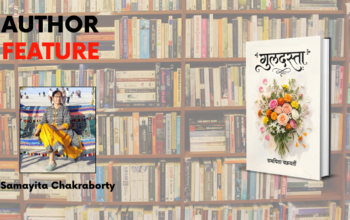
In an era where poetry often oscillates between romantic nostalgia and aesthetic minimalism, Sk Muskan Tabasum emerges as a voice that is unapologetically sharp, socially observant, and emotionally fearless. Hailing from Burdwan, West Bengal, Muskan represents a generation of writers who refuse to romanticize reality without first interrogating it. Her words do not merely decorate pages; they dissect, question, and challenge the comfort zones of modern society.
Her poetry collection, Kaliyuga On My Curls, is not just a book—it is a confrontation. At its heart lies the provocative question: Is Kaliyuga truly the dark age, or have humans conveniently blamed the age to excuse their own moral inconsistencies? This central tension fuels the collection, giving it both philosophical depth and contemporary urgency. Rather than accepting inherited narratives about decline and degeneration, Muskan turns the mirror toward society itself, exposing the ironies embedded in modern relationships, politics, and personal identity.
Muskan’s literary journey did not begin with rebellion alone; it began with reflection. With a strong academic background in literature, she cultivated an understanding of language not merely as an art form, but as a tool of inquiry. While many writers use poetry to celebrate nature or romanticize emotion, Muskan ventures into the uncomfortable territories of the human mind. She probes the loopholes where prejudice hides, the grey spaces where morality becomes selective, and the silent compromises people make in the name of social acceptance.
Her earlier work, Breaking Out: Life from Auto Pilot Mode, marked a turning point in her professional journey in 2022. The book posed a simple yet piercing question: why do we allow “Mr. People” to take control of the steering wheel of our lives? That question continues to echo in her later work, but in Kaliyuga On My Curls, it evolves into something broader and more complex. The focus shifts from individual complacency to collective accountability.
One of the most compelling aspects of Muskan’s poetry is her treatment of feminism. In a cultural climate where feminism is often misunderstood as antagonistic, she reframes it as resistance against prejudice rather than against men. Her sensual and bold section on “women” does not merely advocate empowerment—it embodies it. Through vivid imagery and unapologetic tone, she dismantles the notion that women must remain confined within the boundaries of household expectations or the suffocating grip of “social anxiety,” also known as society itself. Her feminism is not loud for the sake of noise; it is assertive because silence has proven insufficient.
Equally striking is her ability to weave social and political satire into poetic form. War, injustice, and what she describes as “political looney tunes” become subjects of lyrical scrutiny. Yet, her satire does not trivialize suffering. Instead, it exposes absurdities, forcing readers to confront contradictions they may otherwise ignore. There is a certain sting to her verses—an intentional sharpness that lingers after the page is turned. Much like a scorpion’s bite, her poetry grips and unsettles, ensuring that complacency is not an option.
The visual dimension of Kaliyuga On My Curls, complemented by illustrations from Pritha Ghosh, enhances the immersive experience of the collection. The artwork does not merely accompany the poems; it amplifies them, reinforcing the emotional and thematic resonance of each piece. This interplay between text and image reflects Muskan’s understanding that storytelling is multidimensional, and that poetry can extend beyond words into a fully sensory engagement.
Beyond the written page, Muskan is also a performer. Her presence at poetry events allows her to connect directly with audiences, transforming solitary reading into collective experience. Performance adds another layer to her craft, where tone, pause, and expression intensify the impact of her words. It is here that her mission becomes most visible—not simply to publish, but to provoke thought, spark dialogue, and inspire change.
Her intellectual curiosity extends beyond literature. With interests in history, societal structures, and the psychology of human behavior, she approaches poetry as both art and investigation. She seeks to differentiate right from wrong, black from white, while acknowledging the existence of complex grey areas. This willingness to dwell in ambiguity gives her writing authenticity; she does not offer easy answers, but rather invites readers to wrestle with difficult questions.
For Muskan, literary success is not measured by sales alone. It is measured by impact. She aspires to leave an indelible mark on the literary timeline, to see her name woven into the classics, and more importantly, to connect with millions who silently carry unspoken battles. She believes writing has the power to transform pain into strength, confusion into clarity, and suppression into voice. Her ambition is not self-serving—it is rooted in a desire to shape a better world through conscious expression.
In Kaliyuga On My Curls, Sk Muskan Tabasum positions herself not merely as a poet of her time, but as a commentator on it. She challenges the narrative of the “dark age,” suggesting that perhaps the darkness lies not in destiny but in denial. Through satire, sensuality, and social critique, she constructs a body of work that refuses to be passive. Her curls may symbolize softness, but within them resides a storm of questions waiting to be heard.