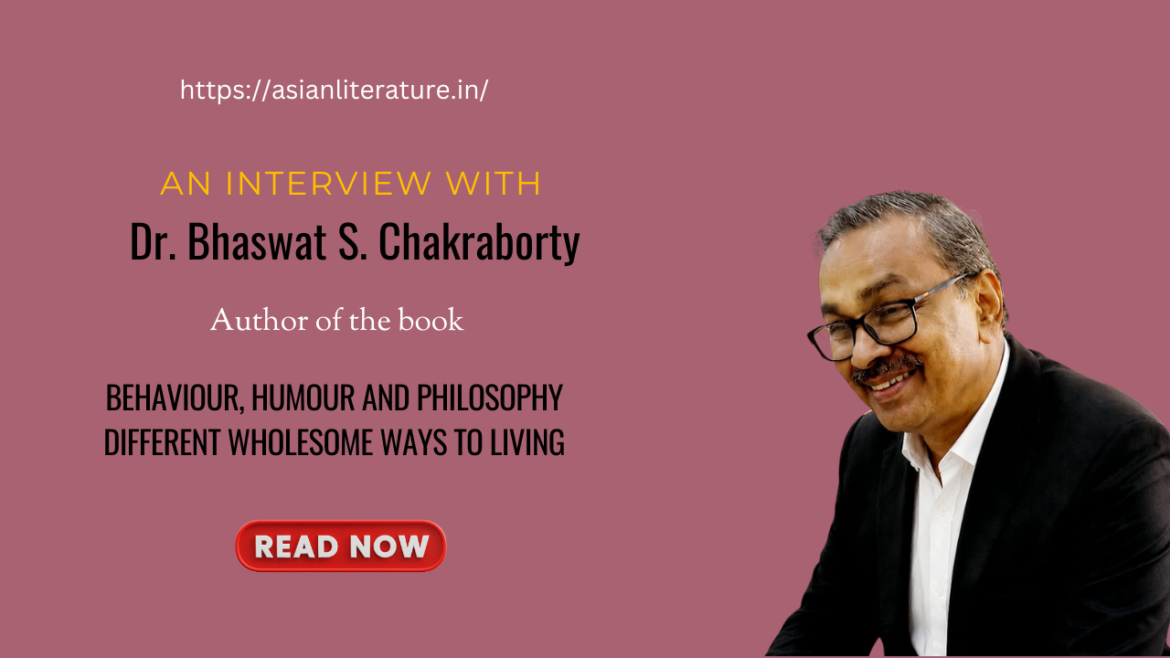
Title: Behaviour, Humour and Philosophy
Author: Dr. Bhaswat S. Chakraborty
ISBN: 978-93-7900-742-1
Publisher: Inksight Publishers
About the Book: This book can be a stepping stone towards a permanent happiness for many people. The goal of this book is rather modest and, perhaps for that reason, more realistic. It is simply to show that life does not have to be a continuous experience of suffering. With thoughtful behaviour, philosophical reflection, and a well-timed sense of humour, human beings may discover that even a complicated world can be navigated with a surprising amount of grace.
About the Author: Prof. (Dr.) Bhaswat S. Chakraborty graduated with a B.Pharm. (Hons.) from IIT, BHU and a PhD in Pharmacology from University of Saskatchewan, Canada. He is a former Professor Emeritus of Ganpat University and Nirma University, India. Before this, Dr. Chakraborty was Senior VP & Chair of R&D of Cadila Pharma, India and President of Foresee Consultants, Toronto, Canada. Prior to that he was Director of Biopharmaceutics at Biovail International, Canada and a Senior Regulator at Health Canada, Government of Canada.
Dr. Chakraborty has served as the Chairman, Pharma and Healthcare Panel, CII; and Senior Regulatory Advisor, New Drugs, Dabur Research Foundation, India. He has also had various honorary important academic, industry & government positions in Canada and USA. He has led 2 of the largest clinical trials coming out of India, trials of 2 international blockbuster drugs and 3 new drugs in India. Recipient of many honors and grants, Prof. Chakraborty has 126 scientific papers (68 full length articles and 48 abstracts) in refereed international journals and has led and reviewed >1200 projects of bioequivalence and clinical trials. Dr. Chakraborty also supervised 24 Masters and 5 PhD students; examined 58 MPharm/ MSc/ MPhil and 1 PhD theses has also many publications and interviews in non-refereed journals.
Dr. Chakraborty also loves to write books. He has written about 20 books and a few more are in progress. He writes in prose as well as poetry. His favorite topics in writing are: Science, Spirituality, Philosophy and Poetry.
Neel Preet: What inspired you to combine behaviour, humour, and philosophy in a single book?
Dr. Bhaswat S. Chakraborty: I was born in India and had my basic university education right there. Then in my early 20’s, I came to Canada, got my higher education and became a citizen of Canada. Canada is truly a multicultural country with immigrants from more than 100 countries. I watched and learnt what is normal to the person of one culture, temperament or ideals, may not be so normal to another culture. For example, humour, dry humour or even satire is more common among Anglo-Saxon workplace cultures than behavioural particulars. I realized that although the essential human values are the same, people from different orientation – be it religion, culture or paradigm – respond differently to the same existential issue or the life challenges.
Neel Preet: How do you think humour influences human behaviour and emotional well-being?
Dr. Bhaswat S. Chakraborty: Humour is the single-most effective answer to most of the helplessness-type of problems. Life— although a great and sacred entity from many viewpoints, it is also an illusory and absurd journey. It makes a powerful being like human being feel like a powerless waste, sometimes. Be it an insult or self-defeating rumination, a well-timed smile and humour is not only an antidote but also serves as a genuine liberator to help you move on.
When I first perceived some of my old childhood wounds surfacing in my adulthood, I once imagined one perpetrator in a torn diaper with his nose running badly. Imagine the caricature. But it worked like magic!
Neel Preet: Your book connects behavioural science with philosophy and spirituality. What motivated this interdisciplinary approach?
Dr. Bhaswat S. Chakraborty: Not only me, this fact of the matter has startled many people, let alone great thinkers, psychologists and divinity practitioners. People (and you yourself) generally notice one’s behaviour as a manifestation or indicator of his inner philosophy and spirituality. Many behavioural therapies of mental diseases are actually more effective for related patients. What we usually call a “virtue” is actually an internalized positive behaviour.
Neel Preet: In your view, how do habits shape a person’s character and moral development?
Dr. Bhaswat S. Chakraborty: By replacing raw, destructive tendencies (vritti) with useful, refined structure of your true nature (svarupa). It is like any other moral or mental training. After a practice for long periods of time, you naturally stop identifying with ego, false narratives etc. You become a true gentleman (or dignified lady).
Neel Preet: You discuss ethical behaviour and social conditioning in depth. How relevant are these ideas in today’s fast-changing world?
Dr. Bhaswat S. Chakraborty: These values are probably more relevant in today’s fast-changing world than they have been ever. No matter how quick or haphazard the apparent outer world is, your true (and consistent) behavioural response puts a stamp of self-assurance and dignity on your personality. It is not only important from someone else’s point of view, when practiced well, you shine as a real Human Being. You never develop complexes like inferiority, guilt, hypocrisy etc.
Neel Preet: The book highlights the connection between spiritual discipline and behavioural transformation. How can ordinary people apply these ideas in daily life?
Dr. Bhaswat S. Chakraborty: Ordinary people are not so ordinary as they are equipped with the spiritual power of coping. Knowledge sharpens the coping and makes it effortless and repeatably consistent. Good behaviour like patience is an antidote to over-sensitivity and over-reaction in almost all daily life situations. Isn’t that true?
Neel Preet: How do philosophy and psychology complement each other in understanding human nature?
Dr. Bhaswat S. Chakraborty: Philosophy is the root “…logy.” All material sciences including psychology have evolved from the metaphysical philosophy. It has guided seers, sages and psychologists alike. Even religion is primarily a robust philosophy along with epistemology (knowledge methodology and axiology (ethics and aesthetics). You learn how to see a being or a mental state as it is in its true nature through philosophy. Psychology develops it further in behaviour and cognition.
Neel Preet: Was there any chapter or concept in the book that was especially challenging or meaningful for you to write?
Dr. Bhaswat S. Chakraborty: Not any chapter in particular. The real challenge was to write with a sharp yet easily readable style and not to repeat some of the core themes. I have written scholarly papers, book chapters, books and project reports in my entire work life. I developed scientific writing skills as needed. I had also written explanatory books on spiritual classics. But writing original books, that too like a pro on spirituality, philosophy, humour, behaviour…. etc. has been attempts since last 8-10 years. So, writing on experientially mature, spiritual and existential topics was a challenge all along, to say the least.
Neel Preet: What role do you think mindfulness, meditation, and self-discipline play in modern society?
Dr. Bhaswat S. Chakraborty: Modern society is modern and advancing only in certain areas— achievement, wealth aggrandizing and opinion forming. Show me a huge number of people who are contented, wise and altruistic. This is not cynicism or scepticism. This is a fact as it is. Don’t we need to be smart and modern in compassion, love and peace of mind as well? Don’t we need stable families and peaceful country-borders? Material wealth cannot give you those. You need to imbibe a primary culture of mindfulness, meditation, and self-discipline along with just enough riches to defeat poverty.
Neel Preet: If readers take away one important message from Behaviour, Humour and Philosophy, what would you want it to be?
Dr. Bhaswat S. Chakraborty: Life is the greatest laurel on earth. Your body, mind, spirit are incredible gifts to you and your community. Recognize them as such. Don’t feel defeated if your being honest has not always paid you off. There is always another beautiful perspective – another viewpoint, another humour about the situation. In its true nature life is deathless, enjoyable at every moment and an opportunity to hour our sages and heroes.