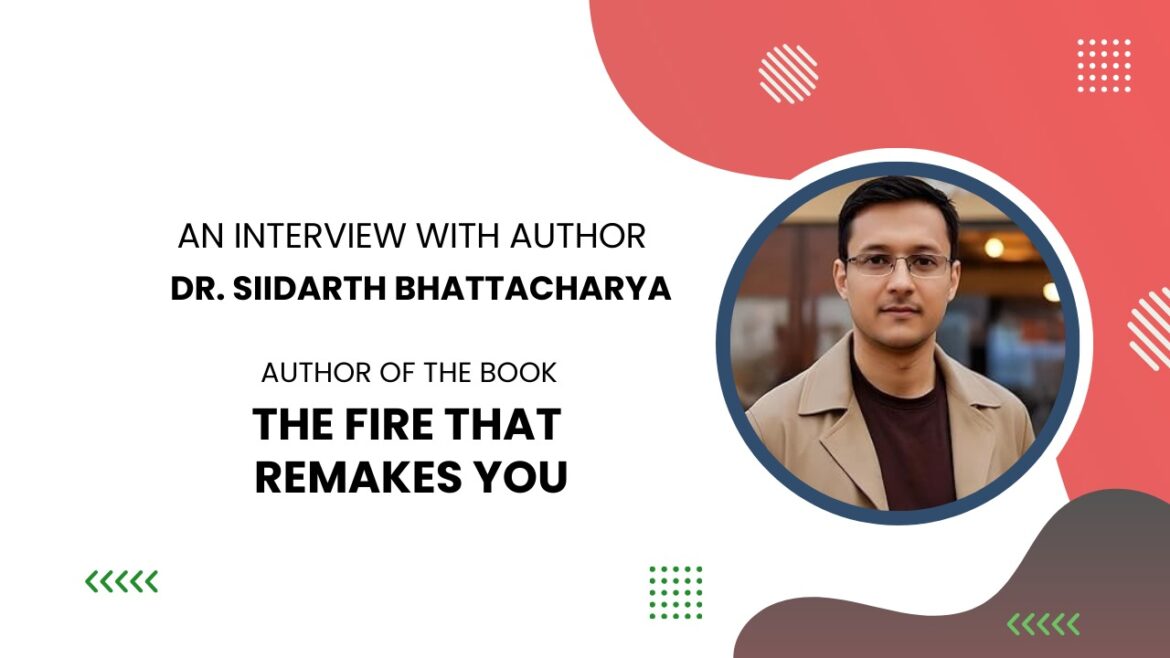
What personal or professional experiences inspired you to write The Fire That Remakes You?
Author: This book was born from collapse — not from success. There was a season in my life when everything that defined me began to unravel. A career shift I didn’t choose. Relationships that fractured. The quiet erosion of identity that no one sees from the outside. I remember staring at the ceiling one night and realizing I wasn’t just grieving events — I was grieving versions of myself. That was my Ashes moment. Professionally, I’ve worked with leaders and high performers who looked strong but were quietly disintegrating inside. I saw how common identity collapse really is. Yet we rarely talk about it. We talk about resilience. We don’t talk about disorientation. This book is my response to that silence. I didn’t want to write another motivational manual. I wanted to write something honest — something that says: collapse isn’t a personal failure; it’s a threshold. And if you learn to stand in it with courage, it becomes the place where your real becoming begins.
You describe this book as a “companion” rather than a self-help manual. Why was that distinction important to you?
Author: A manual tells you what to do. A companion sits with you while you figure it out. When life collapses, people don’t need instructions first — they need understanding. I wrote this book the way I wish someone had spoken to me during my own Ashes season: not with fixes, but with presence. Healing isn’t a checklist. It’s a conversation with yourself. That’s why each chapter feels reflective rather than prescriptive. The journaling prompts aren’t homework — they’re mirrors. The exercises aren’t commands — they’re invitations. I never wanted readers to feel like they were being corrected. I wanted them to feel accompanied. Transformation doesn’t happen because someone shouts solutions at you. It happens when you feel safe enough to face your truth. If this book succeeds, it’s because readers feel less alone in their becoming. That’s what a companion does — it doesn’t lead ahead or push from behind. It walks beside you.
The book is structured into four stages—Ashes, Embers, Spark, and Flame. How did you arrive at this framework?
Author: The framework came from observing emotional cycles — in my own life and in the lives of people I coach. Collapse isn’t linear. But there are recognizable stages. First comes Ashes — the raw disorientation, the identity loss, the quiet devastation. Then Embers — the subtle return of awareness, meaning, and stillness. After that, Spark — the moment you realize you have choice again. And finally, Flame — intentional rebuilding. The metaphor of fire felt deeply human. Fire destroys, yes. But it also refines. Across cultures, it symbolizes rebirth. What struck me during my own collapse was that nothing “new” was added to me. Instead, what was false burned away. That’s when I understood: the ashes aren’t evidence of failure. They are fertile ground. The framework isn’t rigid — it’s reflective. Readers may move back and forth between stages. But naming them gives language to chaos. And when you can name what you’re experiencing, you reclaim agency.
In The Ashes section, you explore collapse and identity loss. Why do you believe collapse is often a necessary stage of transformation?
Author: We tend to think collapse is something to avoid. But collapse reveals what comfort conceals. When everything is working, we rarely question who we are. We live inside roles — professional, partner, achiever. Collapse strips those roles away. It’s terrifying because it feels like losing yourself. But often, you’re losing who you thought you had to be. In my own Ashes season, I realized how much of my identity was performance. Success. Strength. Capability. When those were taken away, I felt empty. But that emptiness wasn’t the end — it was space. Transformation requires space. Something has to fall for something truer to rise. Collapse is not weakness. It is interruption. And interruption creates reflection. The Ashes stage invites honesty — brutal, gentle honesty. It asks: Who are you without applause? Who are you without titles? That’s not a comfortable question. But it is a liberating one.
The chapter The Stranger in the Mirror resonates deeply with readers. What does this chapter represent emotionally?
Author: That chapter captures a quiet kind of grief — the grief of losing yourself while still appearing functional. Many people wake up one day and realize they’ve been living for expectations, not authenticity. They look in the mirror and see competence — but not connection. I’ve experienced that dissonance. The slow disappearance beneath achievement. The Stranger in the Mirror is about identity erosion — the moment you realize you adapted so well that you forgot who you were adapting for. Emotionally, it represents awakening. Painful awakening. But necessary awakening. It’s not dramatic collapse. It’s subtle misalignment. And misalignment is exhausting. That chapter gently asks readers: Where did you trade authenticity for approval? Where did you shrink to stay accepted? It’s confronting — but not condemning. Because once you recognize the stranger, you can begin returning to yourself.
You emphasize that healing is nonlinear. How can readers learn to be patient with their own process?
Author: Healing doesn’t move in straight lines. It spirals. Some days feel strong. Others pull you back into Ashes unexpectedly. I learned patience the hard way — by trying to rush transformation. I wanted to “be over it.” But pain doesn’t obey timelines. One shift that helped me was understanding that setbacks aren’t regression — they are integration. When emotion resurfaces, it’s not proof you failed. It’s proof something still needs witnessing. Patience grows when we stop measuring healing as performance. The goal isn’t to look strong. It’s to feel aligned. I encourage readers to notice micro-shifts instead of dramatic breakthroughs. A clearer boundary. A softer self-talk. A single honest conversation. Those are Sparks. When you honor small movement, you trust the process more deeply. Healing is not about speed. It’s about sincerity.
Your writing blends psychology with symbolism. How do these two worlds complement each other in your work?
Author: Psychology explains what happens. Symbolism gives it meaning. When someone experiences identity disintegration, psychology can describe the pattern — trauma response, burnout, cognitive distortion. But symbolism speaks to the soul. Fire as archetype resonates beyond analysis. It reminds us that destruction and renewal coexist. I never wanted this book to feel clinical. Nor did I want it to feel abstract. Blending the two creates grounding. The science offers clarity. The symbolism offers hope. When readers understand that their collapse has both psychological explanation and archetypal meaning, shame softens. They see themselves as human, not defective. That integration is powerful. We heal best when intellect and emotion walk together.
What role does silence and stillness play in the healing journey, as discussed in The Embers section?
Author: After collapse, there is often noise — advice, expectations, self-criticism. But Embers begin in silence. Stillness is uncomfortable because it removes distraction. Yet it is where truth returns. In my own journey, silence felt like emptiness at first. But gradually, it became clarity. Without noise, I could hear what was mine — and what wasn’t. Stillness allows emotional debris to settle. It’s not passive. It’s restorative. In Embers, we aren’t rebuilding yet. We are listening. That listening rebuilds trust with ourselves. And trust is the foundation of every Spark that follows.
You introduce practices like Rituals of Release and the Fire Ritual. Why is ritual such a powerful tool for transformation?
Author: Ritual marks transition. The mind understands logic. The body understands ceremony. When we consciously release something — a belief, an identity, a story — through ritual, we signal completion. The Fire Ritual isn’t superstition. It’s psychological closure embodied. During my own transition, I realized that intellectual understanding wasn’t enough. I needed a moment that said: this chapter is done. Ritual creates that sacred pause. It honors grief. It dignifies change. It transforms collapse into choice. That is why ritual seals the Flame stage — not as an ending, but as embodiment of becoming.
What would you say to someone who feels they are “too broken” to begin again?
Author: I would say gently: you are not broken — you are becoming. Feeling shattered doesn’t mean you are beyond repair. It means something false has cracked. The Ashes feel final because they are quiet. But beneath them, something is still alive. If you can read these words, if you can ask that question, there is Spark within you. You do not begin again by being strong. You begin again by being honest. The fire didn’t destroy you. It revealed you. And your rise does not require perfection — only willingness.