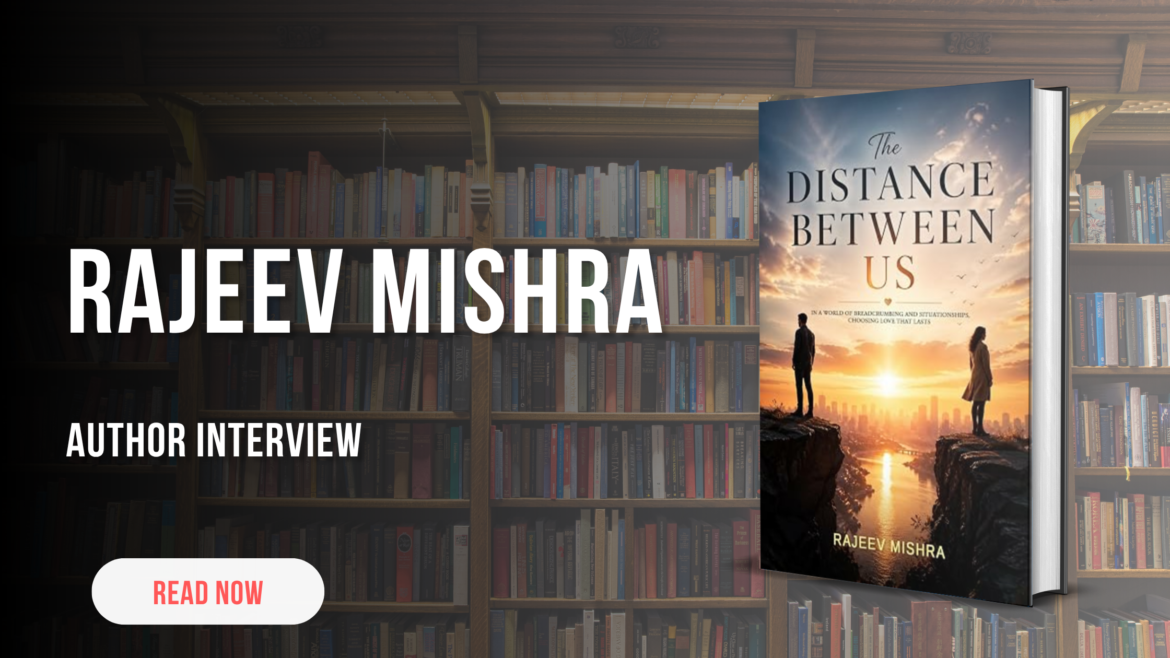
The Literature Times: The Distance Between Us explores the quiet emotional spaces that often exist within relationships. What inspired you to write this deeply reflective book?
Rajeev Mishra:
The inspiration came from life itself. Over more than three decades in business and leadership, I have met thousands of people from different backgrounds. Outwardly, many of them appeared successful, accomplished, and content. Yet, when conversations became personal, I discovered a recurring theme—loneliness, emotional distance, and relationships struggling under the weight of unspoken feelings.
I realized that while we spend years learning how to build careers, very few of us learn how to build lasting relationships. That observation stayed with me. I wanted to write a book that doesn’t judge people or offer easy answers but gently explores the quiet spaces where love often begins to fade. The Distance Between Us is an invitation to pause, reflect, and perhaps reconnect with the people who matter most.
The Literature Times: Your book suggests that relationships rarely fall apart overnight but gradually through silence and unspoken emotions. Why was it important for you to focus on these subtle moments rather than dramatic conflicts?
Rajeev Mishra:
Because real life is rarely dramatic. Most relationships do not end because of one big mistake; they weaken through countless small moments that go unnoticed. A conversation postponed, appreciation left unspoken, a simple “How are you?” never asked—these are the quiet moments that slowly create emotional distance.
I believe literature becomes meaningful when it reflects reality. By focusing on these subtle moments, I wanted readers to recognize that relationships are shaped not only by extraordinary events but also by ordinary daily choices.
The Literature Times: One of the most striking themes in the book is the idea that love changes as people change. How has your own understanding of love evolved over the years?
Rajeev Mishra:
When we are young, we often think love is about excitement, attraction, and finding the perfect person. With time, I have come to believe that love is much quieter than that.
Love is patience during difficult times.
It is choosing understanding over ego.
It is continuing to see the person beside you, even after years together.
People evolve throughout life, and relationships can only survive if they evolve too. Love is not something we find once; it is something we continue to nurture.
The Literature Times: As a business leader and observer of human behavior, how have your professional experiences influenced your perspective on modern relationships?
Rajeev Mishra:
Leadership is ultimately about understanding people. Every organization is built not only on systems but on relationships—trust, communication, empathy, and mutual respect.
Professionally, I have seen brilliant individuals struggle because of unresolved personal relationships, and I have also seen ordinary people achieve extraordinary things because they had emotional support at home.
These experiences reinforced one simple truth: success becomes more meaningful when it is shared. Human relationships influence every aspect of our lives, whether we acknowledge it or not.
The Literature Times: Many readers will likely recognize parts of their own lives in this book. Were any of the emotions or situations inspired by your personal experiences or conversations with people around you?
Rajeev Mishra:
Absolutely.
The stories are fictional, but the emotions are deeply real.
The book draws inspiration from years of conversations with friends, colleagues, families, and people I have met during my professional journey. Naturally, my own experiences and observations also found their way into these pages.
Rather than telling one person’s story, I wanted to capture emotions that belong to all of us. If readers see themselves in these characters, it means the book has done what I hoped it would
The Literature Times: Unlike many relationship books, The Distance Between Us does not offer quick solutions or simple formulas. What kind of reading experience did you hope to create for your audience?
Rajeev Mishra:
I never wanted readers to feel they were reading a manual. Relationships are too complex to fit into formulas. Instead, I wanted the experience to feel like a quiet conversation with someone who understands that life is complicated. My hope is that readers pause after every few chapters—not because they have found answers, but because they have found questions worth asking themselves.
Sometimes reflection creates more lasting change than advice.
The Literature Times: Your previous work explored focus, distraction, and stress among teenagers. What inspired you to shift your attention toward relationships and emotional connection in this book?
Rajeev Mishra:
At first glance, the subjects seem different, but they are closely connected.
Whether we talk about teenagers or adults, the underlying need remains the same—the desire to feel understood, accepted, and emotionally connected.
In my previous work, I explored how external distractions affect young minds. In this book, I explore how emotional distractions affect relationships. Both books ultimately ask the same question: How can we live more consciously in a world full of noise?
The Literature Times: The book emphasizes that love is not just about finding the right person but becoming someone who can truly connect without losing themselves. Why do you think this idea is so relevant today?
Rajeev Mishra:
Because modern relationships often begin with expectations but struggle with acceptance.
We search for someone who completes us, while forgetting that healthy relationships are built by two emotionally secure individuals who continue growing together.
Connection requires vulnerability, self-awareness, and mutual respect. It does not ask us to lose ourselves, but it does ask us to become better versions of ourselves.
That, I believe, is the real challenge of love today.
The Literature Times: If readers could take away one message from The Distance Between Us, what would you hope stays with them long after they finish the final page?
Rajeev Mishra:
I hope they remember that the greatest distance in life is rarely physical.
It is the silence that slowly grows between two people who still care for each other.
And silence can be broken.
One honest conversation.
One apology.
One expression of gratitude.
Sometimes that is enough to begin the journey back to each other.
The Literature Times: What advice would you like to share with aspiring writers who wish to explore complex human emotions and create stories that genuinely resonate with readers?
Rajeev Mishra:
Write with curiosity before you write with certainty. Observe people more than you judge them.
Listen to conversations, notice pauses, and pay attention to what people don’t say as much as what they do.
The deepest stories are not always found in extraordinary events; they often live in ordinary moments.
Most importantly, write honestly. Readers may forget plots, but they never forget how a book made them feel. If your words touch even one heart with sincerity, you have already succeeded as a writer.