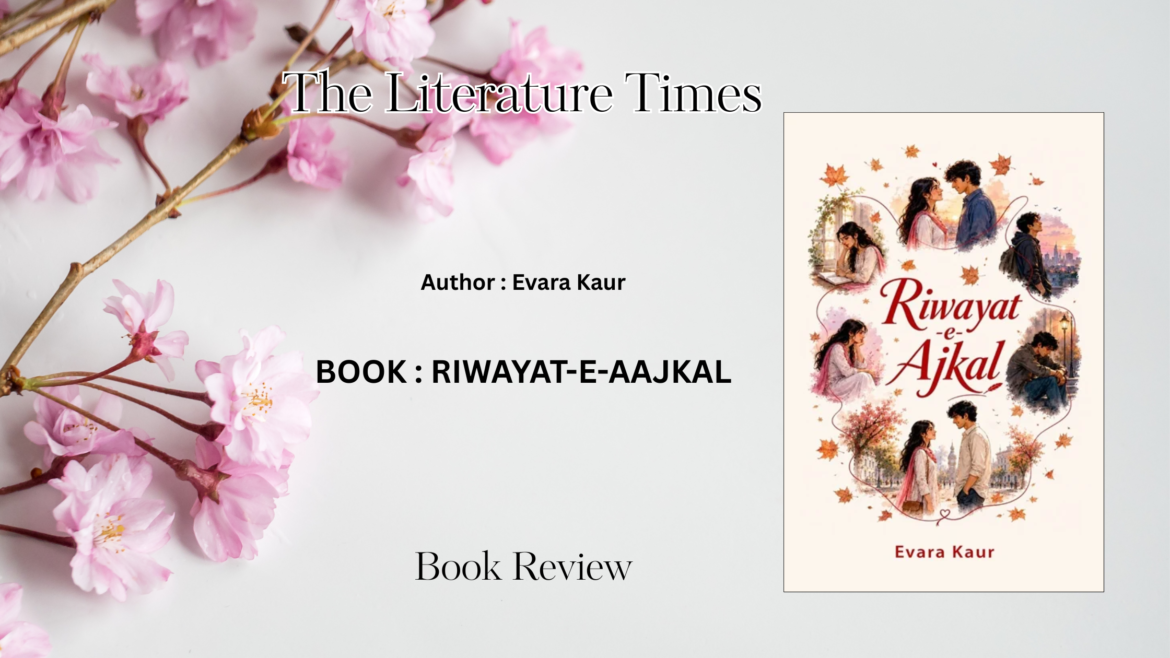
Some books tell a story through characters, places, and events, while others tell a story through emotions that most of us have experienced but often struggle to put into words. Evara Kaur’s collection of two-line shayari belongs to the latter kind. At its heart, the book is an exploration of love and relationships in their many forms, tracing the emotional movement from attraction and curiosity to attachment, uncertainty, heartbreak, healing, detachment, self-love, and finally a more emotionally secure understanding of love. What makes the collection particularly interesting is that the individual ashaar are not presented simply as unrelated pieces of poetry. Instead, they are arranged to create a larger emotional progression, allowing the reader to experience the collection almost like a relationship unfolding one feeling at a time. Each couplet captures a particular emotional or psychological state, and together these moments form a narrative that feels familiar to anyone who has experienced the excitement, confusion, intensity, or vulnerability of modern relationships.
The simplicity of the language is one of the collection’s most accessible qualities. Shayari often carries an association with complex Urdu vocabulary, classical structures, and poetic conventions that can sometimes feel distant to readers who are new to the form. Evara Kaur approaches the tradition differently by using simple yet expressive Urdu vocabulary, allowing the emotional meaning of each couplet to remain at the centre. The verses do not depend entirely on elaborate linguistic ornamentation. Instead, their strength comes from brevity and emotional recognition. A two-line shayari can appear small on the page, yet it can hold an entire memory, conversation, disappointment, or moment of longing. This ability to compress an emotional experience into a few words is central to the charm of the collection.
Another distinctive aspect of the book is its engagement with contemporary relationship dynamics. Love today is often experienced through situationships, inconsistent communication, ghosting, emotional dependence, love bombing, anxious attachment, and the search for emotional clarity. These experiences have become part of the vocabulary through which many young people understand relationships, and the collection brings these modern realities into conversation with the traditional emotional vocabulary of shayari. This creates an interesting meeting point between classical poetic sensibility and contemporary relationship psychology. Instead of presenting love as an idealised emotion that exists outside everyday life, the book recognises that modern love can be uncertain, complicated, intense, and sometimes difficult to understand.
The progression of emotions is perhaps the most significant structural feature of the collection. It begins with the early stages of attraction, where curiosity and excitement can make another person appear almost larger than life. Gradually, the emotional landscape becomes more complicated as attachment develops and uncertainty enters the relationship. The movement towards emotional dependence adds another layer, suggesting how affection can sometimes become closely connected with one’s sense of security and identity. The inclusion of lust, illusion, and heartbreak prevents the collection from presenting romance as something uncomplicated or permanently beautiful. Instead, it acknowledges the contradictions within human relationships. Love can bring comfort and vulnerability at the same time. Attachment can create happiness as well as fear. An intense connection can sometimes be genuine, while at other times it may be shaped by illusion or emotional need.
The English translations accompanying the shayari also broaden the book’s accessibility. Since the original verses are rooted in Urdu expression, translation can be challenging because poetry often depends on rhythm, cultural associations, tone, and emotional suggestion. The purpose here is not simply to make the words understandable but to allow readers who may not be familiar with Urdu to engage with the emotional essence of the verses. This bilingual presentation gives the collection an additional layer of reach without removing its connection to the poetic tradition from which it draws inspiration.
It is also important to understand the book on its own terms rather than comparing it directly with the traditional ghazal form. The collection does not attempt to reproduce the formal structure of a ghazal with a single matla, radeef, and qafia. Instead, it presents standalone couplets connected by a central emotional theme. This choice suits the book’s contemporary purpose because the focus remains on individual moments of feeling while the overall arrangement creates continuity. Each shayari can be read independently, yet its position within the collection contributes to the larger emotional journey.
The later sections dealing with healing, detachment, self-love, and emotionally secure love give the collection a sense of movement beyond heartbreak. This is particularly important because many contemporary love poems remain focused on longing and loss. Here, heartbreak is not necessarily presented as the final destination. The emotional journey gradually turns inward, encouraging reflection and a better understanding of oneself. The shift from seeking emotional fulfilment entirely through another person towards self-awareness and emotional security gives the collection a broader psychological dimension.
Evara Kaur’s background as a young author, poet, and lyricist is reflected in the way she brings together literary sensitivity and contemporary emotional experiences. Her stated influences from psychology, philosophy, and literature are visible in the thematic approach of the collection, particularly in its interest in emotional patterns and self-understanding. Rather than treating poetry merely as decoration for romantic feelings, the book uses poetry as a way of observing those feelings more closely.
Overall, this collection offers a contemporary interpretation of shayari that remains connected to the emotional richness of Urdu poetry while speaking directly to the realities of modern relationships. Its greatest strength lies in its ability to make small moments feel significant. A glance, a silence, an attachment, a disappointment, or the decision to finally let go can become the subject of poetry when expressed with enough emotional precision. By arranging its two-line ashaar as a continuous emotional journey, the collection becomes more than a set of romantic verses. It becomes an exploration of how people fall in love, lose themselves, experience pain, recover, and gradually learn to understand love with greater clarity. For readers drawn to contemporary poetry, relationship themes, Urdu-inspired expression, and emotionally reflective writing, this collection offers an intimate and accessible journey through the many shades of love.