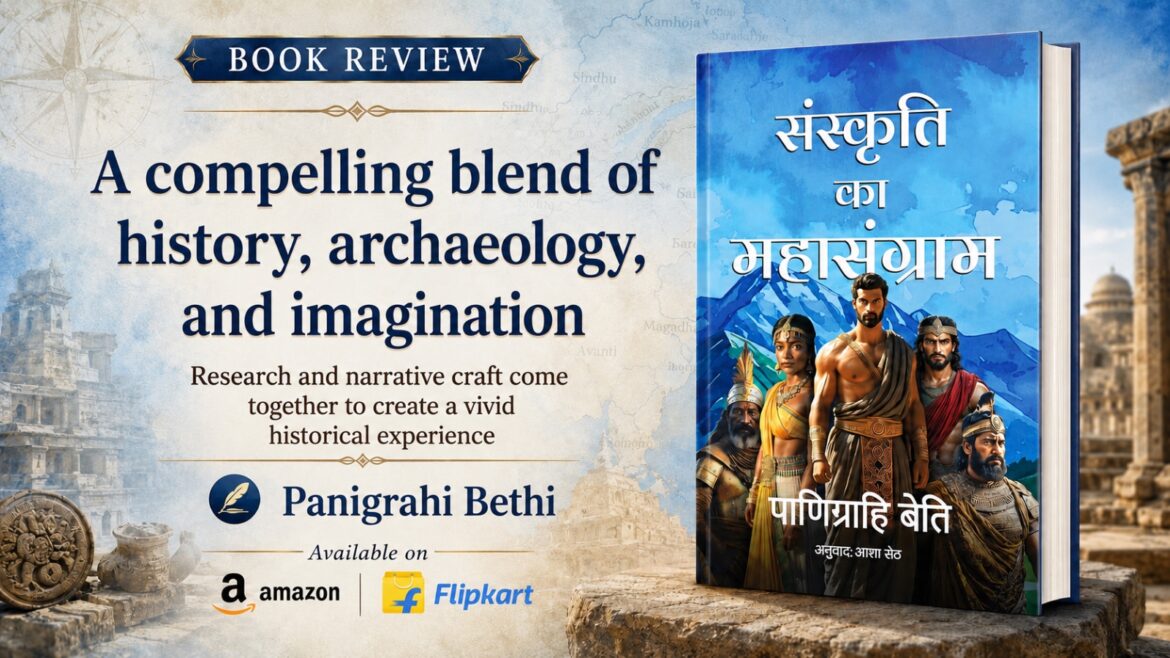
A philosophical reading of Sanskriti Ka Mahasangram and its refusal to reduce history to winners and losers
Sanskriti Ka Mahasangram | Panigrahi Bethi | Hindi Translation: Asha Seth
Historical fiction often arrives carrying a visible conflict: armies advance, rulers decide, cities defend themselves, and the fate of a people appears to depend on a single battle. Panigrahi Bethi’s Sanskriti Ka Mahasangram works differently. Its most important struggle is not fought only with weapons. It unfolds in language, memory, public institutions, private loyalties, inherited assumptions, and the difficult choices people make when the world they understand begins to change.
The Hindi edition of The Greatest Battle of Culture, translated by Asha Seth, imagines the encounter between the Harappan civilisation and the Aryan tradition around 1500 BCE. That description may make the book sound like a conventional civilisational epic, but the novel’s real achievement lies in its refusal to turn the past into propaganda. It does not ask the reader to select one community as permanently enlightened and the other as permanently destructive. Instead, it explores what happens when two different systems of life come close enough to challenge one another.
A Title with More Than One Meaning
The word mahasangram suggests a great battle, yet the novel gradually expands the meaning of battle. Physical conflict is present, but it is only one layer. The deeper contest is between settled urban order and mobile energy, civic systems and warrior traditions, continuity and change, collective memory and emerging identity. The “battle” is therefore cultural, emotional, intellectual, and historical.
This layered interpretation makes the title unusually effective. A civilisation can appear to lose politically and yet survive through habits, technologies, stories, and values absorbed by those who come after it. Another group may gain territory or influence and still be transformed by the people it encounters. Bethi understands that cultural history rarely produces clean victories. What survives is often a mixture created through resistance, adaptation, curiosity, conflict, and human relationships.
Harappa as a Moral Imagination
The Harappan world is presented not merely through archaeological facts but through a philosophy of public life. Its planned streets, drainage systems, trade networks, craftsmanship, and civic organisation suggest a society that expresses its values through infrastructure. The city’s greatness does not depend only on a heroic ruler or a monumental palace. It is visible in systems designed to serve ordinary life.
That choice gives the novel contemporary force. Modern societies often celebrate spectacular symbols of progress while neglecting clean water, public health, equal access, and reliable institutions. Harappa, as imagined here, invites the reader to ask a simple but unsettling question: what if a civilisation’s true achievement is measured not by what it displays, but by how carefully it organises everyday dignity?
Baguhara, the ruler of Harappa, carries this responsibility. He is not written as an ideal king who always knows the correct answer. His strength comes from experience, loyalty to his people, and knowledge of the systems that sustain the city. His vulnerability comes from the same source. A leader who has spent a lifetime trusting a particular order may struggle to recognise when that order must adapt. Bethi makes leadership tragic not because Baguhara lacks wisdom, but because wisdom formed in one world may become insufficient when the world changes.
The Aryan World as Movement and Possibility
The Aryan tradition is given equal narrative respect. It represents mobility, horses, exploration, evolving ritual, martial confidence, and developing philosophical thought. The novel does not present movement as inferior to settlement or energy as inferior to order. It shows that a mobile culture can possess knowledge, courage, adaptability, and a different understanding of community.
This balance is essential. A less careful book might romanticise Harappa and treat the Aryans as a convenient force of destruction. Another might celebrate conquest and reduce Harappa to a civilisation awaiting replacement. Sanskriti Ka Mahasangram rejects both approaches. Every world contains insight and limitation. Every community can be generous and fearful, curious and defensive, creative and rigid.
Through Ashwin and Varun, the novel turns these differences into philosophical conversation. Their debates about authority, belief, tradition, governance, and the responsibilities of a people deepen the narrative beyond adventure. Neither character exists merely to deliver the author’s conclusion. Their arguments remain alive because the novel does not close them with a simple verdict. Readers are invited to continue the debate themselves.
When Personal Transformation Becomes History
Purush’s encounter with Harappa gives the civilisational story an intimate scale. His assumptions do not disappear through one dramatic revelation. They change through experience: walking through the city, observing its public systems, speaking with people whose values differ from his own, and recognising that intelligence can take forms his upbringing did not teach him to expect.
This gradual transformation is one of the book’s most convincing features. Real encounters rarely change people instantly. They create discomfort first. They force comparison. They reveal the limits of inherited certainty. Bethi allows Purush to learn without making him abandon his entire identity. Growth is shown as expansion rather than erasure.
Armita is central to this process, but she is not reduced to a symbolic bridge or romantic reward. Her connection to Harappa is practical, emotional, and intellectual. She knows what the city’s systems mean because she understands the lives supported by them. Her relationship with Purush becomes meaningful because it is built through attention and mutual recognition. Their bond represents cultural encounter without turning either character into an instrument of the other’s development.
The Importance of Moral Even-Handedness
The novel’s greatest intellectual strength is its refusal to simplify. Historical narratives are often recruited into modern identity battles. The past becomes a courtroom in which present communities seek permanent innocence or permanent guilt. Bethi resists that temptation. His characters are neither archaeological exhibits nor political slogans. They are people making decisions with incomplete knowledge.
This even-handedness does not make the novel morally empty. On the contrary, it creates a more demanding moral experience. The reader must consider intention, consequence, fear, power, and responsibility without relying on easy labels. The novel asks whether difference must always become destruction and whether cultural survival depends on purity or on the ability to adapt without losing ethical memory.
Asha Seth’s Hindi Translation
Asha Seth’s translation is especially important because the book’s subject is culture itself. Translating such a novel is not a mechanical transfer of words. It requires preserving the distinction between communities, the rhythm of philosophical dialogue, the emotional weight of loss, and the atmosphere of an ancient world.
The Hindi prose has a natural flow and gives the narrative an immediate cultural intimacy. The translation allows readers to experience the story without feeling that they are receiving a secondary version. It reads as a work that belongs within Hindi literary space while remaining faithful to the architecture of the original.
Why the Novel Matters
Sanskriti Ka Mahasangram matters because it replaces the idea of culture as a sealed inheritance with culture as a living process. Traditions survive not because they remain untouched, but because people carry, question, reinterpret, and share them. The novel understands that transformation can involve grief, yet it also shows that encounter creates new possibilities.
For readers interested in ancient India, the book offers an accessible and imaginative entrance into the Harappan and Aryan worlds. For younger readers, it makes historical questions emotionally engaging without reducing them to a classroom lesson. For contemporary readers, it offers a mature reflection on migration, identity, coexistence, and the meaning of heritage.
Final Verdict
Sanskriti Ka Mahasangram is more than a story about two ancient communities meeting. It is a meditation on how civilisations become part of one another. Panigrahi Bethi combines research, character, suspense, and philosophical inquiry to create a novel that respects complexity. Asha Seth’s translation extends that achievement by making the Hindi edition feel culturally rooted and emotionally complete.
The book’s final insight is both historical and deeply human: the greatest cultural battles do not end when one side wins. They continue inside memory, language, relationships, and the new worlds people build together.
| 5 / 5 | Recommended for readers of Indian historical fiction, ancient civilisations, cultural studies, and thoughtful literary narratives. |
Available on Amazon: https://www.amazon.in/dp/9349988852