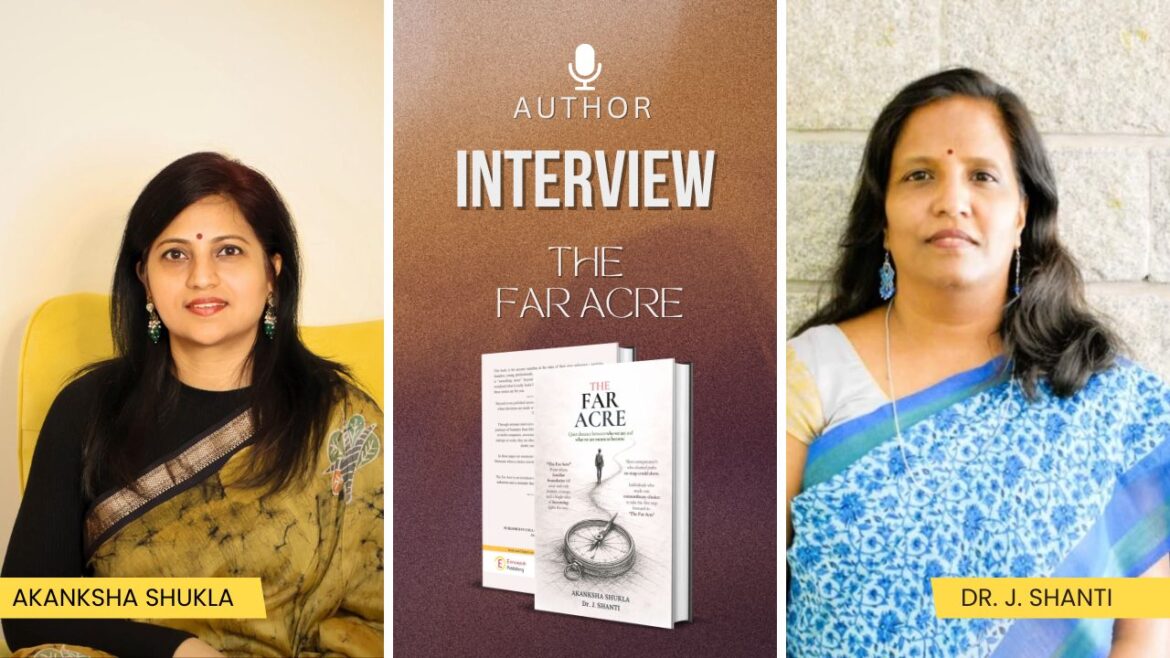
Title: The Far Acre
Author: Akanksha Shukla, Dr. J. Shanti
ISBN: 9789373350646
Publisher: Evincepub Publishing
About the Book
The Far Acre is a thoughtful and deeply human exploration of entrepreneurship that goes beyond success stories to focus on the courage it takes to begin. Through real and honest narratives of founders from diverse fields like agriculture, technology, rural development, and social innovation, the book captures what truly happens behind the scenes of building something meaningful. It highlights moments of doubt, failure, redirection, and quiet determination that often remain unseen but define the journey.
At its core, the book introduces the idea of the “far acre” as a space beyond comfort and certainty – a place where individuals step forward without a clear map, guided only by belief and intent. Rather than presenting fixed formulas or quick success strategies, it encourages readers to reflect on their own paths, choices, and definitions of courage. With its simple and immersive storytelling style, The Far Acre becomes not just a collection of entrepreneurial journeys, but a mirror for anyone who is standing at the edge of a new beginning and wondering whether to take that first step.
About the Authors
Dr. J. Shanti is an Associate Professor of Management at Alliance University, Bengaluru, with nearly two decades of experience in entrepreneurship, sustainability, and enterprise development. Holding a Ph.D. in Management, she brings a strong blend of academic knowledge and industry experience from her time with organizations like Xerox and Marico. As an educator and mentor, she believes in learning through real-life entrepreneurial journeys rather than just theory. Through The Far Acre, she extends her work beyond the classroom, presenting authentic founder stories that highlight resilience, growth, and purpose, making entrepreneurship more relatable and accessible for aspiring individuals.
Akanksha Shukla is a social entrepreneur, storyteller, and the Founder and Director of Meraas Heritage Foundation, where she works to preserve Indian heritage crafts and empower grassroots artisans. She currently serves as the Vice President of the MANAGE Alumni Association and has built a diverse career across marketing, consulting, and social impact in India, Southeast Asia, and the Middle East. Her work has contributed to women’s empowerment and livelihood initiatives, earning global recognition including the UNV Volunteering Award and the World Bank Development Marketplace Challenge. With a strong inclination toward storytelling and community building, The Far Acre marks her first formal literary work, reflecting her passion for human journeys and meaningful change.
Sameer Gudhate: Akanksha Shukla, how has your personal journey influenced this book?
Akanksha Shukla: I’ve always believed in stepping out of my comfort zone and embracing new challenges and experiences. Over the past 19 years, I’ve lived in five different countries across diverse geographies, each with its own cultural and societal fabric. Many times, I chose to move, changing locations and roles, even when life was stable, comfortable, and familiar.
For me, growth has always come from exploring the unfamiliar, trying something new. It builds adaptability, expands perspective, and opens doors you wouldn’t even know existed if you stayed within the familiar.
Professionally as well, I’ve often taken on responsibilities that exposed me to entirely new territories, learning and adapting along the way. For me, learning has always been a continuous process, not a phase.
When the idea of writing this book came up, I felt an immediate connection with the individuals featured in it. In many ways, they too chose paths where the map wasn’t clear, where they had to navigate uncertainty and create their own direction.
This book is more than just a project; for me, it is a reflection of that shared journey, of stepping into the unknown and discovering that clarity and direction are built along the way, not before.
Sameer Gudhate: Dr. Shanti, how has your life experience shaped your perspective in the book?
Dr. Shanti: My career has been shaped by a combination of academic inquiry, corporate experience, and years of mentoring students and aspiring entrepreneurs. In my own journey and in the lives of the founders I profile, meaningful progress has come from uncertainty, continual learning, and steady persistence. Working closely with students and entrepreneurs made clear that success is seldom linear; achievements are built on private doubts, difficult choices, and quiet endurance.
That perspective guided the book. Rather than merely celebrating outcomes, I set out to reveal the human side of entrepreneurship – the trade-offs, the inner shifts, and the decisions that shape a person long before success becomes visible.
Sameer Gudhate: Akanksha Shukla, what does growth mean to you today?
Akanksha Shukla: For me, growth is continuous; it’s not always loud or visible. It often shows up as quiet progress, difficult choices, and the courage to begin again after a setback.
It’s about waking up each day with intention and going to bed knowing you’ve moved, even slightly, toward becoming a better version of yourself.
Growth also means creating meaningful impact in the lives of people around you, no matter how small. It’s about not being limited by circumstances, but choosing to make the most of what life offers you.
When your thoughts are clear and you’re not afraid of failure, opportunities begin to appear everywhere. They may be small or big, but what matters is your willingness to act on them and make them better. That, to me, is growth – a continuous journey of becoming, contributing, and moving forward with intent.
Sameer Gudhate: Dr. Shanti, how do you define real success in life?
Dr. Shanti: Real success isn’t just a tally of achievements, titles, or public recognition. For me, success is a continual journey of growth: becoming wiser, more capable, and becoming a better version of yourself while contributing positively to the lives of others. It requires the courage to pursue meaningful purpose, the resilience to learn from setbacks without losing direction, and the humility to stay grounded when things go well. Ultimately, true success is the quiet confirmation you feel when you look back and see that your efforts created value that outlived your ambitions and served people in ways that mattered.
It asks resilience too – the capacity to absorb setbacks, to learn and adapt without losing direction, and to treat obstacles as instruction rather than indictment. Success shows up when your choices and actions consistently reflect the values you profess, and when those actions generate positive, lasting impact beyond personal gain. Success is visible in how you evolve internally: in the habits you form, the judgments you refine, and the compassion you cultivate. It’s also practical: measured by the tangible, positive change your work leaves behind. When you look back and know that your work has created value beyond yourself, that is true success.
Sameer Gudhate: Akanksha Shukla, have you ever faced a “far acre” moment in your own life?
Akanksha Shukla: Yes, one of my defining “far acre” moments was when I chose to work with the Goodness and Mercy Mission, a Cameroonian NGO, during my tenure with United Nations Volunteers (UNV).
At the time, I had the option to choose from several projects, many of them more straightforward, with clearly defined outcomes and fewer uncertainties. But this particular project stood out. It focused on improving the livelihoods of rural women in Africa, something that deeply resonated with my earlier work with women’s self-help groups in India.
I have always believed that empowering women creates a ripple effect – when a woman’s economic condition improves, she reinvests in education, nutrition, and health for her family and community.
However, this decision meant stepping into completely unfamiliar territory. Until then, I was working as a Charities Coordinator with the Childbirth and Breastfeeding Foundation of Thailand, where my role involved evaluating funding proposals. This new challenge required me to shift from evaluation to creation.
Instead of starting with just writing a proposal, I focused on building a strong, holistic livelihood model – integrating women’s income generation, children’s education, and long-term sustainability. Along the way, I had to upskill myself, including learning the art of grant writing from scratch.
What began as uncertainty gradually turned into clarity through action. The project went on to win the World Bank Marketplace Challenge, and my work with the organization was recognized by UNV.
Looking back, that experience was my first true step into the unknown – where the path wasn’t visible at the start, but revealed itself as I moved forward with intent and conviction. (https://www.unv.org/news/online-volunteers-honoured-outstanding-contributions-peace-and-development)
Sameer Gudhate: Dr. Shanti, how do you deal with difficult decisions?
Dr. Shanti: Difficult decisions are rarely about choosing between right and wrong; they are often about choosing between competing priorities. My approach is to first understand the larger purpose behind the decision and then evaluate the long-term implications rather than short-term convenience.
I believe in gathering information, seeking diverse perspectives, and reflecting carefully. However, there comes a point when no additional information can eliminate uncertainty completely. At that stage, conviction becomes important. I have learned that progress requires action, and even imperfect decisions provide learning that helps shape better decisions in the future. I have learned that forward movement depends on action – accepting that imperfect choices will teach us what to refine next and, over time, lead to better decisions.
Sameer Gudhate: Akanksha Shukla, what role does self-belief play in achieving goals?
Akanksha Shukla: Self-belief is where everything begins.
It is what gives you the courage to take the first step, even when the path isn’t clear. It is what keeps you moving when things go wrong, and what anchors you when uncertainty sets in.
When the map thins out and direction feels uncertain, self-belief is what keeps you focused on your goal. It allows you to stay persistent, adapt, and continue learning even in the face of setbacks.
At its core, self-belief is not just a motivator; it is the foundation of achievement. Without it, goals remain ideas. With it, they become journeys in motion.
Sameer Gudhate: Dr. Shanti, how important is patience in building something meaningful?
Dr. Shanti: Patience is undervalued in an age that glorifies rapid scaling and overnight wins. We often celebrate rapid growth and instant success, but meaningful achievements are usually the result of consistent effort over long periods of time. True, lasting achievements – whether a startup, a career, or a relationship – more often grow from steady daily effort than from sudden breakthroughs. Progress frequently unfolds quietly and incrementally long before it shows up on metrics or in headlines.
Patience lets founders trust the process, keep learning, and stay committed when visible results lag. In doing so, it converts persistence into sustainable success. Two of the examples of patience by founders are:
When their brother was diagnosed with ALS, the Heywood brothers founded PatientsLikeMe to help patients share experiences and learn from one another. Instead of rushing to scale quickly, they spent years building trust within patient communities, carefully designing features that genuinely served people’s needs. The company grew methodically to 15 patient communities and over 80,000 users discussing 19 diseases in less than five years – but only because they prioritized deep value over rapid expansion.
Mailchimp started in 2001 as a small email marketing tool and grew for two decades without taking external funding. The founders patiently reinvested profits into product development and customer experience, scaling slowly but steadily. By refusing to rush for venture money or chase viral growth, they built a billion-dollar company rooted in customer loyalty and long-term trust.
Sameer Gudhate: Akanksha Shukla, what fears do people face before starting something new?
Akanksha Shukla: The greatest fear people face before starting something new is the fear of failure, the uncertainty of stepping into the unknown without a clear map to guide them.
We live in a society that celebrates success but often overlooks the value of trying. Failure is frequently judged, rather than being understood as a lack of effort, it should be understood as proof that someone dared to begin.
In reality, failure is not the opposite of success; it is part of the process. It signifies effort, learning, and growth.
What truly defines success is the willingness to try something new with an open mind, accepting that things may not go as planned, but choosing not to stop. Resilience, adaptability, continuous learning, and consistency are what ultimately shape outcomes.
In many ways, the greatest risk is not failure; it is never discovering what could have been possible if you dared to step beyond the familiar and begin. That is what we have tried to showcase in the book: the courage to step into uncertainty and embrace the unknown is what sets these entrepreneurs apart; the risk of failure is offset by their grit, conviction, and sheer belief in their ideas.
Sameer Gudhate: Dr. Shanti, how can one overcome self-doubt?
Dr. Shanti: Self-doubt is a natural part of growth because every new challenge takes us beyond familiar territory. Every meaningful challenge pushes you beyond familiar territory, into places where competence hasn’t yet been proven. The goal isn’t to eliminate self-doubt; that’s impossible. The real work is preventing it from becoming a barrier that stops you from taking action.
One effective way to overcome it is by focusing on small wins and consistent progress rather than perfection. Every step forward builds confidence. Equally important is who you surround yourself with. Self-doubt intensifies in isolation; it softens when you’re with people who encourage growth, offer constructive perspectives, and remind you of what you’ve already accomplished. Seek mentors, peers, and colleagues who won’t just praise you but will challenge you thoughtfully, help you see blind spots, and hold you accountable to your goals. Their presence creates a supportive environment where doubt becomes data rather than a stop sign.
Finally, remember that confidence is rarely built before action – it’s built through action. You don’t wait until you feel confident to start. You start, and confidence grows as you move. The first time you speak up in a meeting, the first time you pitch an idea, the first time you ship imperfect work, you’re not proving you’re ready – you’re becoming ready. Action is the bridge between doubt and belief.
Sameer Gudhate: Akanksha Shukla, how do you stay connected to your purpose?
Akanksha Shukla: Staying connected to your purpose is not a one-time realization; it’s an ongoing practice. It requires continuous reflection, conscious choices, and consistent action.
Along the journey, you will encounter roadblocks, detours, and moments of uncertainty. What anchors you in those moments is your ability to pause, reflect, and realign with your core values.
Equally important is the environment you create, being surrounded by people who share your vision and challenge you to stay true to it.
Purpose is sustained when your actions remain aligned with your intent. It’s this alignment – between what you believe and what you do: that keeps you grounded, even when the path ahead is unclear.
Sameer Gudhate: Dr. Shanti, how do you balance ambition and responsibility?
Dr. Shanti: Ambition gives us direction – it points toward where we want to go. Responsibility provides balance – it keeps us honest about how we get there. I believe ambition should never be pursued at the expense of people, core values, or long-term purpose. When ambition becomes a reckless hunger for personal gain, it damages relationships, erodes trust, and often leads to short-lived success.
Throughout my career, I have approached ambition as a tool for creating meaningful impact rather than merely achieving personal accolades.
This means asking not just “What do I want to achieve?” but also “Who will this affect, and how will it shape the future?” Responsibility ensures that our decisions consider their broader consequences – on teams, communities, customers, and the environment. It asks us to weigh the real cost of our choices and to act with integrity even when the easier path offers faster results.
When ambition is guided by purpose and tempered by responsibility, it becomes sustainable and meaningful. It stops being a fire that burns out quickly and becomes a steady light that guides us through uncertainty. This kind of ambition builds institutions that endure, relationships that strengthen over time, and legacies that outlast personal achievement. It creates success that doesn’t just look good on paper but feels right in practice – success that honors the people who made it possible and the values that make it worth having.
Sameer Gudhate: Akanksha Shukla, what advice would you give to someone afraid of failure?
Akanksha Shukla: For me, the greatest failure is not trying.
When you take a step, even with uncertainty, you give yourself a chance – a chance to learn, to grow, and possibly to achieve what you set out to do. But if you hold back out of fear, that chance becomes zero.
I often tell my mentees that stagnation is the real failure – not moving, not attempting, not exploring what could be possible.
Failure, on the other hand, is active. It means you tried. It means you stepped forward. And every attempt brings you closer to clarity and improvement.
So my advice is simple: don’t let the fear of failure stop you from beginning. Because the only guaranteed failure is never starting at all.
Sameer Gudhate: Dr. Shanti, how should one handle setbacks in life?
Dr. Shanti: Setbacks are not interruptions to the journey; they are part of the journey itself. Every meaningful endeavor involves obstacles, disappointments, and moments when things do not go according to plan.
The most important thing is to view setbacks as sources of learning rather than evidence of failure. Reflection helps us understand what can be improved, while resilience helps us move forward. Many of the entrepreneurs featured in this book succeeded not because they avoided setbacks, but because they learned from them and continued despite them.
Sameer Gudhate: Akanksha Shukla, how important is support from family or community?
Akanksha Shukla: More than support, what truly matters is the environment you are part of.
Are you surrounded by people who encourage growth, or by those who are skeptical, fearful, and constantly focused on limitations? The energy around you shapes how you think, how you act, and how far you are willing to go.
When you are in a nurturing and accepting environment – one that allows you to fail, learn, and try again without judgment – you naturally develop the courage to take risks.
Such an ecosystem doesn’t just support you; it enables you. It gives you the confidence to explore possibilities, stay resilient, and keep moving forward.
Because the truth is, opportunities are always there. What makes the difference is having clarity of thought, conviction in your path, and an environment that allows you to believe that growth is possible, that is when hope replaces fear.
Sameer Gudhate: Dr. Shanti, can success be achieved alone?
Dr. Shanti: While individual effort is important, lasting success is rarely achieved alone. Every accomplishment rests on a foundation of different people associated with us, like mentors offering guidance, colleagues sharing the workload, family providing emotional support, communities creating opportunity, and networks opening doors – contributions that are sometimes visible and often invisible.
Entrepreneurship is fundamentally a collaborative journey. Founders may spark the initial idea, but teams transform it into reality, partners extend its reach, customers validate its value, and supporters sustain it through difficult early years. Recognizing and valuing these contributions strengthens relationships, which are qualities that keep leaders grounded. The founders in The Far Acre confirm this: they credit mentors, rely on teams who stayed through years of near-zero revenue, and built ventures where collaboration was valued over individual heroics. Success that endures is built on relationships, effort, humility, and perseverance.
Sameer Gudhate: Akanksha Shukla, what keeps you grounded despite achievements?
Akanksha Shukla: I don’t see achievements as final milestones; I see them as moments within a much larger journey of learning.
For me, life is a continuous process of becoming. Small success is not an endpoint, but an opening, an opportunity to take on something bigger, to learn more, and to grow further.
What keeps me grounded is this perspective: I value the process more than the outcome. The real fulfillment comes from learning, evolving, and staying curious, not from reaching a particular destination.
And as soon as one journey reaches a milestone, it becomes a cue to begin again. That mindset, of always being a learner, always moving forward, is what keeps me grounded and keeps me going.
Sameer Gudhate: Dr. Shanti, what habits help in long-term growth?
Dr. Shanti: Long-term growth isn’t built through occasional bursts of intense effort; it’s built through consistent habits practiced daily. Curiosity, continuous learning, reflection, discipline, and adaptability have been the core habits shaping my own journey. Each one serves a purpose: curiosity opens doors to new possibilities, learning keeps us growing, reflection helps us understand what works and what doesn’t, discipline ensures we stay consistent even when motivation fades, and adaptability allows us to evolve when circumstances shift.
I also place deep value on the habit of observation; paying careful attention to people, systems, and emerging opportunities, as I observed a few of the founders featured in the book. This means watching how others navigate challenges, noticing patterns in how organizations function, and recognizing quiet signals of change before they become obvious to everyone else. Growth happens when we remain open to learning from every experience and are willing to evolve as circumstances change. Small, consistent improvements over time create extraordinary results.
The founders featured in The Far Acre embody these habits in powerful ways. One founder spent years quietly observing customer behavior before ever launching a product, using that disciplined observation to identify a gap the market didn’t yet see. Another practiced continuous learning by deliberately working outside their comfort zone – taking on roles and projects that challenged their assumptions and expanded their capabilities. A third founder built their venture through consistent daily habits rather than dramatic breakthroughs: morning routines for reflection, structured time for learning, and regular conversations with mentors that kept them grounded while pushing them forward.
Their stories confirm what I’ve learned in my own journey: extraordinary results come not from dramatic leaps but from small, consistent improvements practiced daily. When ambition is guided by purpose and responsibility, and when growth is built through habits rather than bursts, the path becomes sustainable, and the outcome becomes meaningful. That’s the kind of long-term success that endures beyond headlines and outlasts temporary wins.
Sameer Gudhate: Akanksha Shukla, what is one belief that changed your life?
Akanksha Shukla: “Focus on your next step.”
No matter how big the ambition is, whether it’s building a business or creating impact, it’s easy to get overwhelmed by the end goal. While having a vision is important, over-focusing on it can sometimes stop us from even beginning.
What I’ve learned is to see the journey as a series of small, manageable steps. When I tried to think about everything at once, I often found myself stuck. But when I shifted my focus to just the next step, progress became possible.
Clarity doesn’t come from overthinking the outcome; it comes from action. As you move forward, you learn, adapt, and discover what truly works for you.
And if, along the way, your direction changes, that’s okay. Growth is not linear – interests evolve, and so do paths.
So instead of being consumed by the result, I’ve learned to invest my energy in the process, taking one step at a time. Especially in uncertain situations, focusing on the next step is what creates clarity and keeps you moving forward.
Sameer Gudhate: Dr. Shanti, what message would you give to your younger self?
Dr. Shanti: I would tell my younger self not to wait for perfect clarity before taking action. Some of life’s most meaningful opportunities reveal themselves only after we begin – once we move, commit, and show up. Waiting for certainty often means waiting for something that never arrives. The path doesn’t become clear while standing still; it becomes clear while walking. The founders in our book, The Far Acre, confirm this: the founders did not wait for a complete roadmap before launching ventures. They started with what they had, learned as they moved, and discovered opportunities invisible to those who stayed on the sidelines.
A few other things I would want to tell myself about: Growth takes time – it happens through the steady accumulation of experiences, both positive and challenging. Every failure teaches something; every success builds confidence. Trust the process, stay curious, continue learning, and never underestimate perseverance. The path may not always be visible, but each step forward creates the clarity needed for the next one. The founders in The Far Acre navigated uncertainty by walking through the fog, not waiting for it to lift. Begin before you’re ready. Let perseverance be your compass. The clarity you seek arrives not through waiting, but through doing.