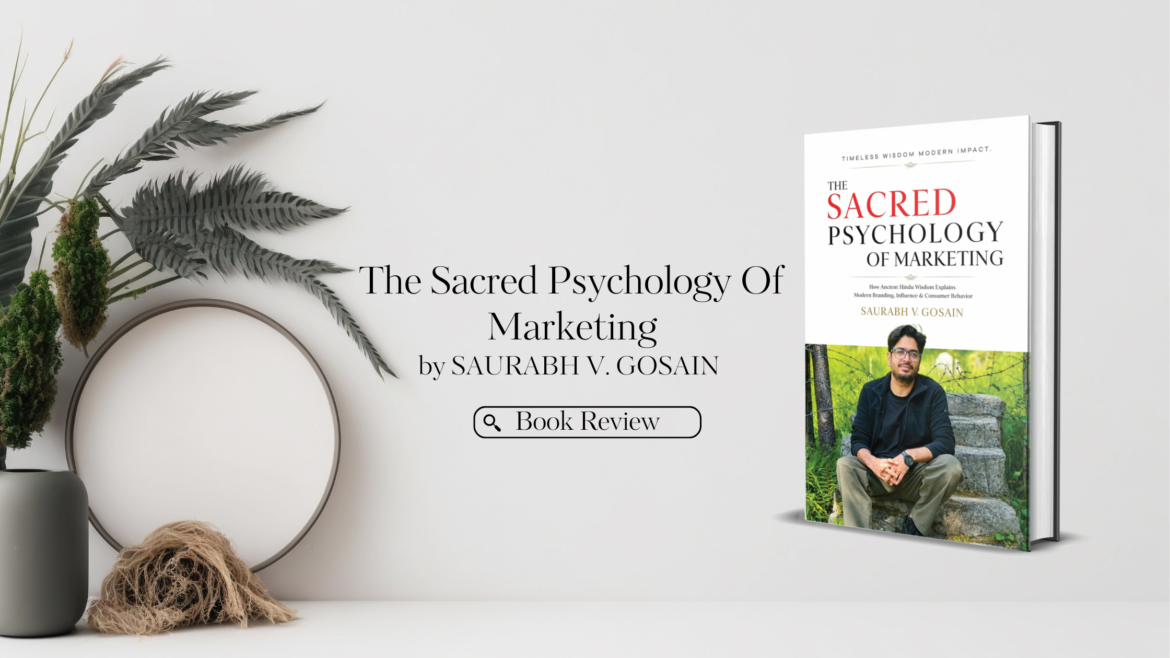
In a marketplace shaped by attention, emotion, trust, and constant competition, The Sacred Psychology of Marketing by Saurabh V. Gosain offers a thoughtful attempt to look beyond conventional marketing tactics and explore the deeper forces that influence human behaviour. The book brings together two seemingly different worlds, ancient Hindu philosophy and modern marketing, to ask an important question: Can branding and business become more meaningful when they are rooted in a deeper understanding of human nature? Through its exploration of Dharma, Manas, Vāk, Buddhi, Samskāra, and Prabhāva, the book presents a framework for understanding how people perceive, think, desire, decide, and connect with brands.
One of the book’s strongest qualities is its central idea that successful marketing is ultimately about understanding people. Modern marketers often focus on data, algorithms, customer journeys, conversion rates, and digital strategies. While these tools are important, Gosain argues that beneath all of them lies the human mind. By drawing from Hindu philosophical concepts, the book encourages readers to examine perception, emotion, intellect, memory, influence, and action as interconnected aspects of consumer behaviour. This makes the discussion particularly relevant in an age when consumers are surrounded by thousands of commercial messages every day. The book suggests that brands cannot create lasting relationships simply by demanding attention. They must understand what people value and why certain messages create emotional and psychological connections.
The six foundational principles provide the intellectual foundation of the book. Dharma introduces the idea of purpose and responsibility, encouraging marketers and businesses to think about the larger meaning behind their actions. Manas focuses on the mind and its emotional responses, while Vāk explores the importance of speech and communication. Buddhi represents intellect and discernment, reminding readers that consumers do not always make decisions purely through emotion. Samskāra brings attention to impressions, memories, habits, and experiences that shape behaviour over time. Prabhāva, meanwhile, addresses influence and impact. Together, these ideas create a framework through which marketing can be understood not merely as selling, but as an interaction between human psychology, communication, values, and social influence.
The structure of the book also contributes to its accessibility. Divided into three sections, Understanding Human Nature, Hindu Wisdom and Strategy, and Modern Branding Lessons, the book gradually moves from philosophical and psychological foundations toward practical marketing applications. This progression allows readers to first understand the individual and then consider how these insights can be applied to branding and business strategy. Rather than presenting ancient concepts in isolation, Gosain attempts to connect them with familiar realities of the modern marketplace.
The section exploring Krishna, Rama, and Hanuman as strategic archetypes is particularly interesting because it moves the discussion from abstract philosophy into recognizable cultural narratives. These figures are presented not simply as religious icons but as sources of strategic and behavioural insights. The approach encourages readers to look at qualities such as leadership, duty, courage, discipline, communication, adaptability, and service through a contemporary strategic lens. For readers interested in both Indian philosophy and management thinking, this intersection can offer a fresh perspective on familiar stories.
Another important strength is the book’s use of real-world brand examples. References to brands such as Amul, Apple, FabIndia, and Zudio help translate philosophical concepts into recognizable marketing situations. These examples demonstrate how ideas such as identity, ritual, community, aspiration, trust, and emotional connection can operate within contemporary branding. Luxury branding, for instance, is not simply about expensive products. It is also about perception, symbolism, exclusivity, and the story consumers associate with ownership. Similarly, rituals and communities can transform an ordinary product into something that becomes part of a person’s lifestyle or identity.
The book becomes especially relevant when it discusses the relationship between influence and ethics. Marketing has enormous power to shape preferences, aspirations, and purchasing behaviour. In such an environment, the question is not only whether a brand can persuade people, but also whether it should. By bringing Dharma into the conversation, Gosain introduces an ethical dimension that is often missing from discussions about growth and persuasion. The idea that business actions should have meaning and responsibility gives the book a broader purpose. It invites marketers to consider the consequences of their communication and the kind of relationships they want to build with consumers.
Saurabh V. Gosain’s professional background strengthens this discussion. With nearly 15 years of experience across sales, branding, and business strategy, he approaches the subject with practical marketing knowledge while drawing equally from his interest in psychology and spirituality. His journey from retail sales to becoming a marketing consultant gives the book a perspective that is both professional and reflective. Rather than treating spirituality as a separate subject, he attempts to integrate it into everyday decision-making, communication, leadership, and business practice.
Ultimately, The Sacred Psychology of Marketing is more than a conventional marketing book. Its real contribution lies in encouraging readers to reconsider what marketing means when viewed through the lens of human psychology and ancient wisdom. It does not reject modern branding techniques. Instead, it asks readers to look beneath them and understand the deeper motivations that make those techniques effective. For marketers, founders, communicators, and students of consumer behaviour, the book offers an opportunity to think about branding not only as a commercial activity but also as a form of communication and influence that carries responsibility. In a marketplace increasingly dominated by speed and distraction, Gosain’s message is timely: lasting brands are built not only through visibility, but through meaning, trust, purpose, and a genuine understanding of people.