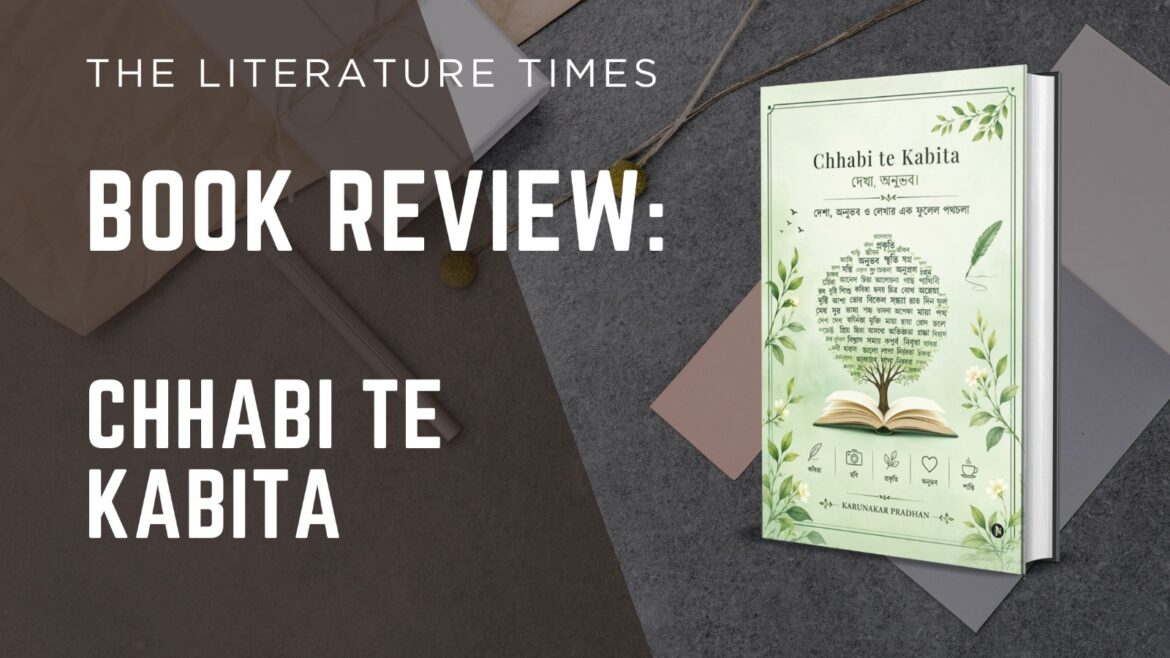
Poetry has traditionally been understood as an art of words, rhythm, imagery, and emotion. But Chhabi te Kabita by Karunakar Pradhan invites the reader to reconsider that definition. Bringing together ninety visual and concrete poems, the book explores a form in which words do not merely communicate meaning through sentences; they also become shapes, patterns, spaces, and visual compositions. The result is a collection that sits intriguingly between literature and visual art, asking readers not only to read poetry but to look at it.
At the heart of the book is an experimental idea: the physical arrangement of language can become part of its meaning. In conventional poetry, the reader generally moves from one word to the next, following a linear progression. Visual poetry disrupts that familiar movement. The eye may move across, around, or through the composition, taking in its shape before fully engaging with its language. This makes the act of reading more exploratory and gives the page itself an active role in interpretation.
Pradhan’s collection is particularly interesting because the visual form is not presented simply as decoration. The poems use typography, spacing, arrangement, and symbolic shapes as components of expression. A poem can therefore operate simultaneously on two levels. There is the linguistic meaning contained in its words, and there is the visual meaning created by their placement. When the two work together, the reader encounters something closer to a visual metaphor—an idea that is communicated not only by what the poem says but also by what it looks like.
This approach places Chhabi te Kabita within the broader tradition of concrete poetry, a form that gained considerable prominence during the twentieth century. Concrete poets challenged conventional assumptions about how poems should occupy a page, often arranging words to reflect their subjects. A poem about the sun might take a circular form; a poem about a musical instrument might visually echo that instrument. Such compositions transform the poem from a sequence of lines into an object that can be viewed as a whole.
What makes Pradhan’s project noteworthy is the scale of his experimentation. Ninety visual poems represent not merely an occasional departure from conventional writing but an extended engagement with the possibilities of the form. The collection draws upon a diverse range of symbolic references, including elements of nature, musical instruments, cosmic imagery, and cultural signs. This variety gives the project considerable creative scope, as each subject presents a different opportunity to explore the relationship between image and language.
The visual component also changes the role of the reader. With a conventional poem, the reader primarily follows the poet’s linguistic sequence. In visual poetry, that sequence can become less predictable. The reader may first notice a shape, then identify words within it, and finally begin connecting the visual structure with the poem’s emotional or conceptual meaning. Reading becomes a process of observation and interpretation rather than simply progression from one line to another.
That quality makes the collection particularly relevant to contemporary literary experimentation. In an age dominated by screens, graphics, symbols, and rapidly consumed visual information, the boundaries between written and visual communication are increasingly fluid. Yet Chhabi te Kabita does not simply imitate digital aesthetics. Its central concern remains poetic expression. The visual structure is used to deepen the relationship between an idea and its representation.
There is also an important element of restraint in the concept. Visual poetry can easily become a purely aesthetic exercise if the shape overwhelms the words. The success of such a poem depends on whether the visual arrangement contributes something meaningful to the subject. Pradhan’s stated approach—that the structure should be intrinsic to the poem rather than ornamental—is therefore central to understanding the collection. When form and content reinforce one another, the page becomes part of the poem’s vocabulary.
The book also challenges readers to slow down. Traditional poetry can be read relatively quickly, but a visual poem often demands a second look. Its meaning may not become immediately apparent, and the reader may need to consider why particular words occupy particular spaces or why a specific shape has been chosen. This encourages a more contemplative engagement with the page.
Chhabi te Kabita can consequently be viewed as both a poetry collection and an experiment in literary form. It expands the possibilities of what a poem can be without abandoning language as its foundation. Its ninety compositions demonstrate an ongoing attempt to discover how visual perception can interact with emotion, symbolism, and ideas.
Ultimately, Karunakar Pradhan’s Chhabi te Kabita is an invitation to experience poetry differently. It reminds us that words possess not only sound and meaning but also physical presence. They can form images, create movement, suggest symbols, and alter the way a reader encounters an idea. By bringing these possibilities together, the collection turns the page into a meeting point between poetry and visual art. For readers interested in experimental literature, concrete poetry, and unconventional forms of expression, this is a collection that encourages a simple but significant shift in perspective: sometimes, a poem does not only tell us what to see—it becomes something we can see.