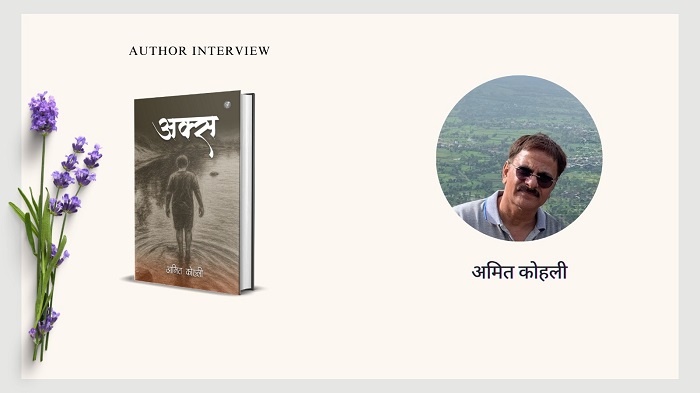
The Literature Times: Your book “Aks” explores love in many incomplete and silent forms. What inspired you to write about this particular emotional landscape?
Amit Kohli: Love, in its truest essence, is rarely complete. It often lingers in silences, in glances, in the unspoken. I was drawn to these fragments because they mirror the human condition, our love, union, separation, our hesitations, our quiet surrender. “Aks” was born from observing how love often exists more in absence than in presence, more in yearning than in fulfillment.
The Literature Times: Many of your poems emerge from moments of emptiness and inner questioning. How do you personally navigate such moments while writing?
Amit Kohli: Emptiness is not something I try to escape; it is a space I inhabit. In those moments, I listen rather than speak. Writing becomes a way of conversing with silence, of shaping questions into metaphors. The act of poetry allows me to transform inner voids into shared experiences, so that emptiness itself becomes fertile ground.
The Literature Times: You describe “Aks” as a spiritual document rather than just a poetry collection. What does spirituality mean to you in the context of your work?
Amit Kohli: For me, spirituality is not ritual, it is awareness. It is the ability to see beyond the surface of emotions, to recognise the reflection of something larger in our smallest gestures. “Aks” is spiritual because it seeks not just to express feelings, but to trace the journey of the soul through love, detachment, and silence.
The Literature Times: The poems in “Aks” carry a quietness that feels intentional. How do you use silence as a literary device in your writing?
Amit Kohli: Silence is the most eloquent language we have. In poetry, silence is the pause between words, the breath between lines, the unsaid that lingers after the page is turned. I use silence to invite readers into the poem, to let them complete it with their own emotions.
The Literature Times: You’ve mentioned that your poems are not written for one person, yet readers may find their own reflections in them. How do you create such universality in deeply personal poetry?
Amit Kohli: I write from my own truth, but I avoid naming or narrowing it. Instead of telling a story of “me”. I try to evoke a feeling of “us”. When emotions are distilled to their essence – loss, longing, hope – they transcend individuality. That is how personal poetry becomes universal.
The Literature Times: Music seems to be an integral part of your life. Does music influence your writing style or the themes you choose?
Amit Kohli: Absolutely. Music teaches me rhythm, pause, and resonance. Just as a raga can evoke dawn or dusk, poetry too can carry moods beyond words. I often think of my poems as compositions, where cadence matters as much as meaning. Music reminds me that silence is also sound, and poetry must honor that.
The Literature Times: Having worked in school education and community initiatives for two decades, how has that experience shaped your perspective as a poet?
Amit Kohli: Working with children and communities has taught me humility. It has shown me that poetry is not only for the page, it must live in the world. My experiences in education and social work remind me that words carry responsibility. They must illuminate, not obscure; they must connect, not isolate.
The Literature Times: Your book balances themes of love, detachment, and spiritual search. Was it challenging to maintain this balance while compiling the poems?
Amit Kohli: The challenge was not in balancing, but in listening. Each poem carried its own weight, some leaned toward love, some toward detachment, some toward the spiritual unknown. My task was to weave them together so that they formed a journey, not a contradiction. The balance emerged naturally, like light and shadow coexisting.
The Literature Times: Do you believe that poetry has the power to heal emotional wounds, both for the writer and the reader?
Amit Kohli: Yes, poetry heals, not by offering solutions, but by offering recognition. When a reader finds their own pain reflected in a poem, they feel less alone. When a writer releases their emotions into verse, they find clarity. Healing in poetry is subtle, but profound, it is the quiet assurance that our wounds are shared.
The Literature Times: What message or feeling do you hope stays with readers after they finish reading “Aks”?
Amit Kohli: I hope readers carry with them a sense of reflection, that love, silence, and longing are not weaknesses but pathways to understanding ourselves. If “Aks” leaves them with a quiet pause, a moment of stillness where they feel both fragile and infinite, then the book has fulfilled its purpose.