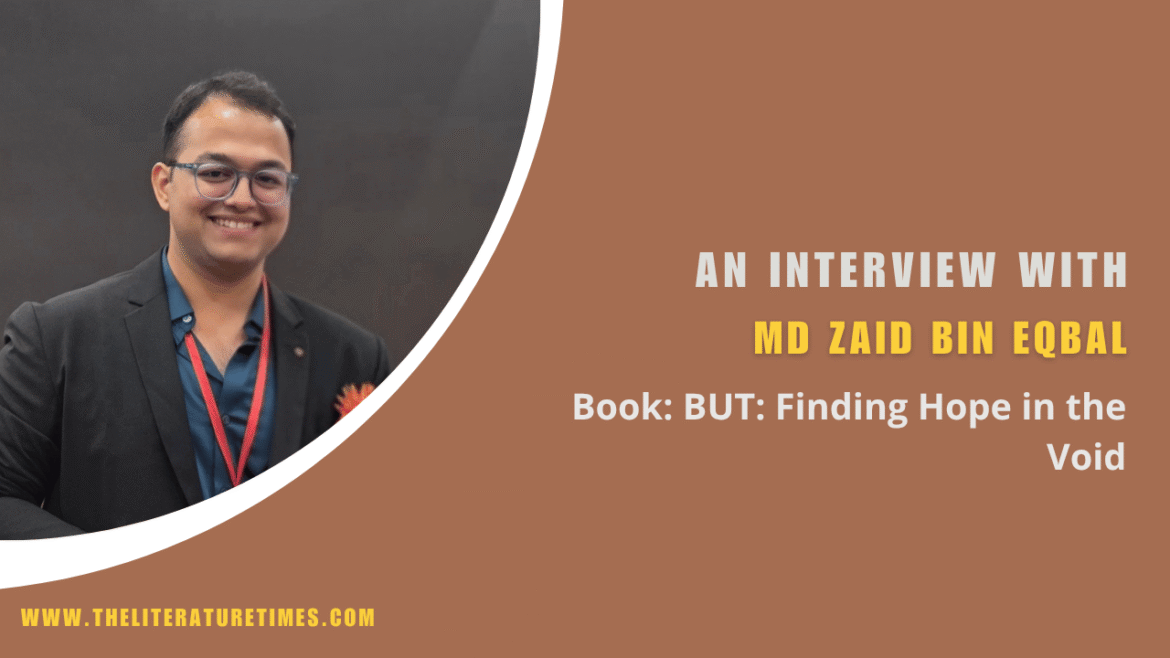
The Literature Times: Your debut book, BUT: Finding Hope in the Void, explores loneliness, self-doubt, and invisible struggles. What inspired you to write this book?
Md Zaid Bin Eqbal: I never actually had it in my mind that I would write a book. I started writing simply because it was a time when I felt I could be more myself through writing. Most of the time, I would start writing about something I could relate to something I had gone through, something I was thinking about, or something I wished I had known when I was going through it.
Eventually, I started observing people around me. I have always considered observation one of my strengths, and I realized that many of the problems I faced were not mine alone. There were people around me going through the same things, carrying the same questions and fighting battles that looked different from the outside but felt surprisingly similar.
And somewhere along the way, all those writings, observations, experiences and thoughts slowly became a book.
The Literature Times: The word “BUT” plays a central role in the book. What does this word mean to you, and why did you choose it as the title?
Md Zaid Bin Eqbal: Frankly speaking, I never thought about the name of the book when I started writing it. I simply kept writing.
Then, somewhere between those days of writing, the word “BUT” struck me. And somehow, it felt right.
What initially started as writing gradually began to take a different shape. In a way, the book itself turned into BUT.
I didn’t choose the word after deciding what the book should be. The word found me somewhere in the process of writing it.
The Literature Times: As a medical student, writer, and observer of human behaviour, how has your medical education influenced the way you understand emotional struggles?
Md Zaid Bin Eqbal: Medicine has taught me that what we see is not always the complete picture.
A patient may walk into a hospital with a physical complaint, but behind that complaint can be fear, anxiety, family pressure, financial difficulties, or years of emotional exhaustion. Studying medicine has made me more attentive to the human being behind the symptoms.
It has also taught me not to reduce people to what is immediately visible. In many ways, that understanding became an important part of my writing. Human beings are much more complicated than the version of themselves they show to the world.
The Literature Times: Your book does not promise easy solutions or endless positivity. Why was it important for you to present hope in such an honest and realistic way?
Md Zaid Bin Eqbal: I can’t promise that I will be able to help you within the exact period in which you read this book, because everyone has their own capacity and capabilities to make things work.
That’s why I have always focused more on taking time before taking decisions rather than giving someone a fixed timeline for when they should feel better.
I don’t want the book to tell someone, “Read this and everything will be fine.” Healing and finding your way through difficult situations are deeply personal processes.
Sometimes, you simply need time to understand what you’re going through before you can decide what to do about it.
The Literature Times: Many people carry struggles that others cannot see. What do you hope readers will understand about invisible emotional burdens after reading your book?
Md Zaid Bin Eqbal: I hope they understand that not everything someone is going through will be visible to us.
We often judge people based on what they show us, without knowing what they are carrying underneath. Someone can smile, talk normally, go to work, attend college and still be dealing with something internally.
I think sometimes the best thing we can do is simply not assume that we know someone’s entire story from what we can see.
The Literature Times: How did your own experiences and difficult questions shape the themes and reflections found in BUT: Finding Hope in the Void?
Md Zaid Bin Eqbal: My own experiences played a huge role in shaping the book. But what made it even more meaningful was seeing how much other people could relate to those same thoughts.
Many of my friends have told me that when they read the book, it feels like I am sitting there having a conversation with them.
For me, that simple compliment is life-winning.
Because that was never about trying to sound like an author. I wanted the writing to feel like a real person was talking to another real person. If someone can read my words and feel understood, then I think the writing has already done something meaningful.
The Literature Times: Your writing touches on loneliness, identity, pressure, and the search for meaning. Which of these themes do you feel is most misunderstood in today’s society, and why?
Md Zaid Bin Eqbal: For me, it would be loneliness.
What I have seen is that people can’t really see through the mask that hides loneliness.
Someone can be surrounded by people and still feel completely alone. They can laugh, socialise, post pictures, have friends and appear perfectly fine, while internally feeling disconnected.
I think that’s what makes loneliness so misunderstood. We often look for loneliness in isolation, when sometimes it is hiding in plain sight.
The Literature Times: What was the most challenging part of transforming personal reflections and lived experiences into a book that others could connect with?
Md Zaid Bin Eqbal: For me, the biggest challenge was giving the book a feel of reality.
I didn’t want to be someone sitting comfortably on the other side, writing as though I had figured everything out and was simply giving advice to people who hadn’t.
I wanted the reader to believe that I was once there too—and perhaps, at some point, I still am.
I am not better than you. I am not someone who has everything figured out.
I am you.
And if I can find my way through certain things, then I believe you can find your way through yours too.
That connection was much more important to me than making the book sound perfect.
The Literature Times: If you could speak directly to someone who is currently going through a difficult period and feels that things will never get better, what would you want them to take away from your book?
Md Zaid Bin Eqbal: Honestly, the first thing I would do is sit with them and hear them out.
I wouldn’t immediately start telling them what they should or shouldn’t do. If it takes hours, then it takes hours. I would sit there and listen.
And then, according to what they are going through, I would talk to them.
Because sometimes people don’t need an answer immediately. Sometimes they just need someone who is willing to stay long enough to hear the question.
The Literature Times: As you continue your journey in medicine and writing, how do you see these two worlds intersecting in your future work?
Md Zaid Bin Eqbal: For me, they aren’t really two different worlds. They are pretty much the same in one important way: both ultimately focus on making someone’s life better.
Medicine allows me to understand people professionally and scientifically, while writing allows me to explore the thoughts, emotions and experiences that make us human.
There are several more aspects of human thinking that I would love to professionally dive into and explore. I want to understand those dimensions more deeply and hopefully create something new and more understandable from them.
I don’t know exactly where those two journeys will take me, but I know I want to keep exploring the space where understanding a person becomes as important as understanding their problem.