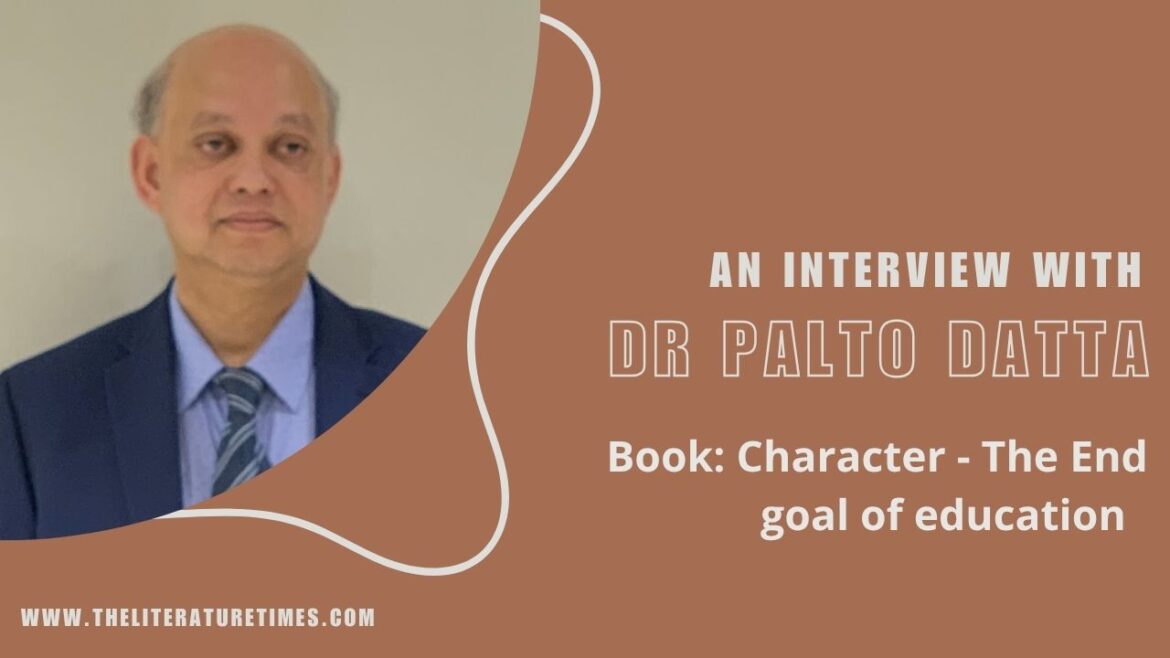
Literature Times: Dr. Datta sir your book argues that education should inspire character, virtue, and development rather than just academic excellence. What personal or professional experience first led you to this conviction?
Dr Datta: At the outset of the book, I have clearly stated that education is key to the development of a human being. It serves as the basis through which societies build their future. As for today, however, it is becoming evident that the traditional education system cannot deal with current or anticipated problems in the context of rapid change. This book argues that education needs to expand beyond the simple passing of information to focus on character formation, moral education, and the development of the person as a whole. As an educator and a researcher, I have been privileged to witness the robust impact education can have on people’s lives. My belief is based on both my early life experiences in my home country and my work as a professional teacher in the UK and beyond for more than 27 years. Many academically “successful” students/learners lacked empathy, resilience, or an ethical foundation, as I have seen in my decades of working with students on several continents. During times of crisis, such as social upheaval, economic instability, or even in class discussions, this disparity became much more apparent. A student’s long-term influence on society is largely determined by who they become as well as what they learn. I came to see that education must focus on developing the full person with intellect, heart, and soul rather than only imparting knowledge or aiming for grades. I strongly believe current education system in this world is not fit for the purpose to develop a moral, responsible and accountable citizens. This is why the world becomes more corrosive.
Literature Times: You integrate philosophies like Ubuntu and Stoicism with modern educational concepts like Sustainable Development. How do you see this combination enriching today’s global education systems?
Dr Datta: One of the greatest tragedies of human nature is that we tend to forget the past and blindly accept the trends of the present. The past should serve as the foundation for the present, and the present should guide the future. Only then will we develop greater moral character and resilience. Fundamental moral principles ought to direct our actions. We can establish a fantastic growth and moral mindset by learning some of those excellent moral values from our past. Ubuntu is one of the great African philosophy that teaches us “I am because we are”—a call for shared humanity. Stoicism, on the other hand, empowers learners with inner resilience and purpose. When these are interwoven with goals of Sustainable Development, we shift education from mere utility to unity. Global challenges—climate change, inequality, conflict—demand education that produces wise, collaborative, and morally grounded leaders. These philosophies provide timeless tools to nurture such individuals who can act with compassion while thinking critically and globally.
Literature Times: The book critiques the obsession with standardized testing and rote learning. What alternatives would you propose to measure real student growth and learning?Dr Datta: The overriding prominence of any education system invigorates learners to become more independent, curious, open-minded, and think outside the box. Educational Institutions should seek to create and maintain a community of learners qualified for the programme’s rigorous academic, professional. Education is not measuring the indicators, getting scores and standardised testing. We need to measures what matters. There are better indicators for holistic development of any learners such as Portfolio assessments, reflective journals, project-based learning, peer reviews, and socio-emotional growth metrics. Imagine evaluating a student not just on what they remember, but on how they think, collaborate, adapt, or show moral courage. That’s real education. Assessment should be a mirror of growth—not a scoreboard of fear.
Literature Times: How can schools practically integrate character-building initiatives into existing curricula without overwhelming teachers and students?
Dr Datta: I am not at odds with the academic progress; instead, I suggest focussing more on developing the intellectual character of learners as the fundamental purpose of education than accumulating specific knowledge with ambiguity. Such disposition will help learners develop broader knowledge and understanding across the domain. Knowledge disposition for truth-seeking, curious and open-minded learners can be applied adequately and appropriately in different contexts- From a classroom experience to solving a real-life problem. The intelligent character will assist learners in developing solid habits of mind and thought patterns. Character-building need not be an “add-on”—it should be a lens through which subjects are taught. Literature can explore empathy, history can reflect on justice, science can examine responsibility. Teachers can start with small, consistent practices: reflective discussions, ethical dilemmas, gratitude exercises, community projects. When character is woven into pedagogy, rather than tacked on, it becomes second nature—not a burden.
Literature Times: You advocate for ‘caring criticism’ and collaborative learning. How do you envision policy makers and educators institutionalizing these values in a competitive educational framework?Dr Datta: We all are witnessing a homogeneous trend worldwide: the loss of noble values such as relationships, family bonds, honesty & integrity, politeness, respect for others, selflessness, and togetherness. Are there any ways we can bring these values back to the character? Yes, only an education system that focuses on character education. Such education is imperative to the revival of national importance. Therefore, within the educational content educational ppolicy must shift from performance pressure to purpose. Institutions can incentivise collaborative projects, peer teaching, and dialogic learning. Evaluation systems should reward constructive feedback, creativity, and emotional intelligence. “Caring criticism” means offering truth with kindness—it builds trust. Policies need to support professional development that trains educators to create safe, reflective, and inclusive learning environments.
Literature Times: How has your multidisciplinary academic background—from plasma physics to marketing—shaped your perspective on the purpose and philosophy of education?
Dr Datta: My multidisciplinary academic journey from the rigors of plasma physics in Moscow to the strategic landscape of marketing has deeply shaped my understanding of education’s true purpose. In Moscow, we didn’t just study physics. We immersed ourselves in philosophy and history. This blend was not accidental; it was intentional and deeply enriching. It taught me that education should not be compartmentalised. Physics cultivated in me a respect for logic, precision, and the mysteries of the universe. Philosophy pushed me to question the foundations of knowledge itself. History offered the context to understand the present. Marketing later added the layer of human behaviour, communication, and societal interaction.
Together, these fields helped me realise that no subject exists in isolation. When we segregate disciplines too strictly, we also fragment the learner’s worldview. And unfortunately, modern education often driven by economic efficiencies has leaned heavily toward specialisation, sometimes at the cost of holistic thinking. True education should not be confined to the mastery of content alone. It must nurture critical thinking, ethical awareness, historical consciousness, and the ability to synthesise ideas across boundaries. The purpose of education is not merely to produce workers for the market, but to shape conscious, adaptable, and reflective individuals who can contribute meaningfully to society.
In that sense, I believe every student, whether studying science, business, or the arts, should also be grounded in philosophy and history. These disciplines are not luxuries; they are essential for cultivating wisdom. Education, at its best, is a lifelong dialogue between the self, society, and the world.
Literature Times: Given the rise of AI and automation, what specific character traits or virtues do you believe future generations will need the most—and how can education systems nurture them?
Dr Datta: In today`s era of marketing Darwinism, Globalisation and 4th Industrial revolution we cannot reject AI rather we all must embrace it to create opportunities for us but with care. In academy, we all have been going through a transformative process and development journey. In an AI-dominated future, the most valuable human traits will be empathy, critical thinking, ethical judgment, adaptability, and self-awareness. Machines can process data, but they can’t process dignity. Education systems should prioritize these traits through self-reflection, cross-disciplinary learning, and exposure to real-world problems. Let’s raise humans, not humanoids.
Literature Times: What role do parents and communities play in supporting the vision of education outlined in your book, beyond the classroom walls?
Dr Datta: Children are heavily influenced by their immediate environment, particularly their family. They form a strong emotional bond with family members because they spend most of their time with them. As a result, a long-term, loving, and caring relationship between parents/family and child is critical. Community plays a great role in shaping children’s moral character. Education begins at home and is sustained by the community. Parents must model integrity, curiosity, and kindness. Communities must create spaces libraries, cultural centers, mentoring circles, where character is lived, not just taught. When values are echoed in the home, school, and society, learning becomes meaningful and transformative.
Literature Times: Your call for radical but optimistic change in global education structures is bold. What are the first practical steps institutions can take to initiate this transformation?
Dr Datta: Start small, start now. I always say that small is beautiful. Means saying God of small things. Begin with rethinking mission statements to include character. Provide professional development on emotional intelligence and ethical reasoning. Redesign classrooms for dialogue, not just delivery. Partner with NGOs for real-world learning. Every policy, curriculum, or timetable tweak must ask: Will this help build a better human being?
Literature Times: If a young educator were to read your book today, what core message would you want them to take away and apply throughout their career?
Dr Datta: You are more than a transmitter of knowledge, you are a builder of futures. Teach not just minds, but hearts. Help students become not just competent, but compassionate. Remember, every lesson is an opportunity to shape a life. Let your teaching be a lighthouse in a world often lost in the fog of performance.