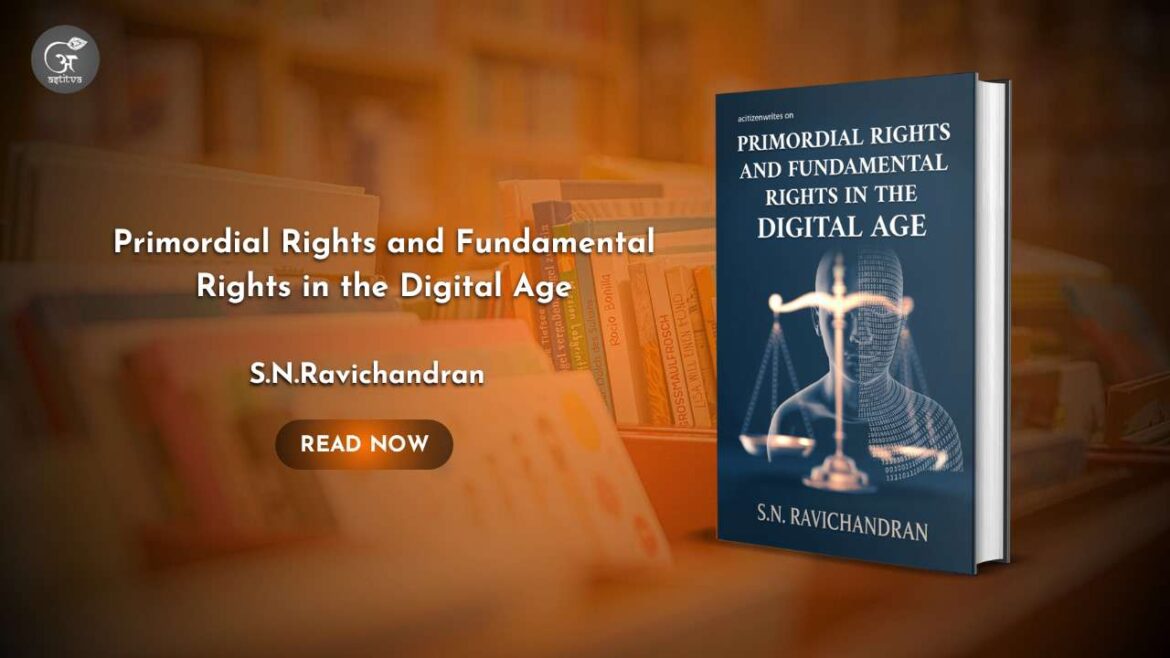
In a time when digital footprints are both unavoidable and deeply personal, Primordial Rights and Fundamental Rights in the Digital Age by S.N. Ravichandran emerges as a timely and essential contribution to the discourse on civil liberties in a digital world. The book offers a rigorous and accessible exploration of two foundational freedoms: the right to privacy and the right to freedom of speech and expression, both of which are being tested by the expanding reach of technology, surveillance, and regulatory frameworks.
The book is presented in two distinct but interconnected parts. The first part delves into the Right to Privacy, tracing its philosophical roots as a natural right and examining its codification and recognition in various legal systems around the world, with a keen focus on India. In doing so, the author lays out a detailed understanding of personal data, its attributes, and how it has come to define privacy in the digital age. Particularly relevant is the book’s critical analysis of the Digital Personal Data Protection Act 2023, a recent and controversial piece of legislation in India. Ravichandran highlights key gaps and concerns in the Act, questioning whether it truly empowers citizens or merely provides a façade of control in a data-driven environment.
The second part of the book shifts its focus to freedom of speech and expression, an equally crucial and often contested right. With careful scrutiny, the author compares its treatment in European, American, and Indian contexts, offering readers a global perspective on the evolving interpretations and limits of this freedom. Of notable importance is the detailed examination of Section 66A of the Information Technology Act, a provision struck down by the Supreme Court of India. The author dissects the ramifications of this landmark judgment and its continuing relevance, especially in light of ongoing debates about censorship, misinformation, and online harassment.
S.N. Ravichandran brings both scholarly depth and field experience to this work. As a seasoned cyber-crime investigator, his insights are grounded in the real-world complexities of law enforcement, data protection, and digital ethics. His background in applied sciences, public policy, and strategic studies allows him to bridge the gap between technical realities and legal principles. His extensive engagement with the Tamil Nadu Police, financial institutions, and educational bodies adds a practical dimension that enriches the theoretical arguments presented in the book.
Primordial Rights and Fundamental Rights in the Digital Age is not only a legal commentary but also a call to consciousness. It invites readers—especially students, legal professionals, policy-makers, and informed citizens—to critically reflect on the rights they hold, the rights they risk losing, and the responsibilities they must uphold in an era dominated by data and digital influence. In doing so, Ravichandran has delivered a compelling and necessary book for our times.