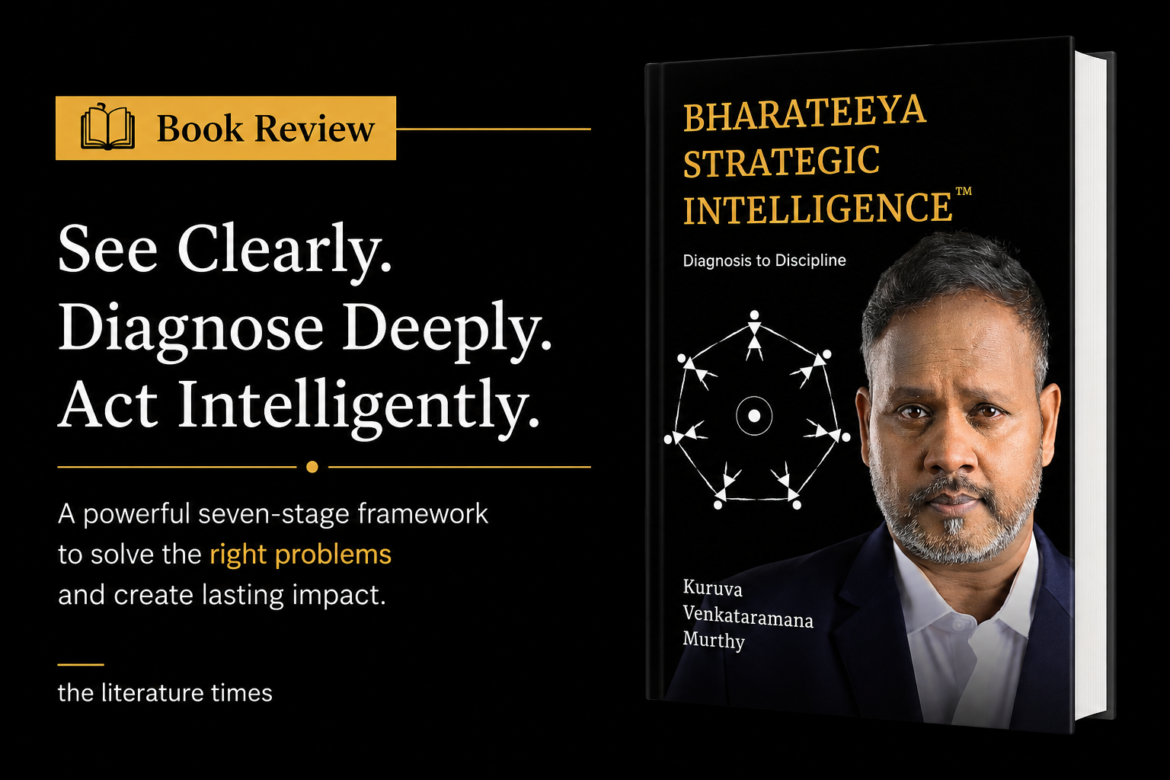
In a world overflowing with information, management models, productivity hacks, and leadership frameworks, organizations continue to struggle with a surprisingly fundamental challenge: identifying the real problem before attempting to solve it. Kuruva Venkata Ramana Murthy’s Bharateeya Strategic Intelligence: Diagnosis to Disciplineaddresses this challenge with remarkable clarity and offers a disciplined approach to decision-making rooted in both practical experience and Bharateeya strategic wisdom.
The book begins with an observation that immediately resonates with entrepreneurs, business leaders, and professionals alike. Most strategic failures do not occur during execution. They occur much earlier—when leaders misdiagnose the problem itself. Sales decline, and companies hire more salespeople. Employee turnover rises, and organizations increase salaries. Customers complain, and businesses offer discounts. While these responses may appear logical, they often address symptoms rather than causes.
This central premise forms the foundation of the Bharateeya Strategic Intelligence™ (BSI) framework, a seven-stage methodology designed to help individuals and organizations identify the true point of resistance that prevents progress. Murthy argues that the most expensive mistake in business is not making a wrong decision but making the right decision for the wrong problem. It is a simple statement, yet one with profound implications.
What makes the book particularly valuable is its structured framework. Rather than presenting abstract theories, Murthy introduces seven interconnected stages:
Drishti – Seeing the situation clearly and objectively.
Nischaya – Making deliberate choices based on clarity.
Bodha – Creating understanding and alignment among people.
Swadharma – Building strategies around inherent strengths and natural capabilities.
Margarekha – Sequencing actions intelligently and systematically.
Pramaan – Validating assumptions through evidence and measurable outcomes.
Sadhana – Executing with discipline, consistency, and commitment.
Each stage builds naturally upon the previous one, creating a logical pathway from diagnosis to implementation. The framework feels less like a traditional management model and more like a disciplined thinking process that can be applied across industries, professions, and personal decision-making contexts.
One of the book’s strongest qualities is its emphasis on clarity. Murthy repeatedly challenges readers to question assumptions and examine whether they are addressing root causes or merely reacting to visible symptoms. This perspective is especially relevant in today’s fast-moving business environment, where leaders are often pressured to act quickly rather than think deeply.
The author successfully bridges ancient Bharateeya wisdom and contemporary strategic challenges without forcing the connection. Instead of treating traditional knowledge as a philosophical backdrop, he demonstrates how timeless principles of observation, self-awareness, discipline, and deliberate action can strengthen modern decision-making. This integration gives the framework a unique identity that distinguishes it from many Western management methodologies.
Another notable strength is the book’s practicality. Every chapter concludes with worksheets and guided exercises, encouraging readers to apply the framework to real situations. Rather than simply consuming information, readers are invited to actively diagnose their own challenges and work through the seven stages. This hands-on approach significantly enhances the book’s usefulness as a working guide rather than a one-time read.
Murthy’s writing style is direct, accessible, and focused. He avoids unnecessary jargon and complex academic language, making strategic thinking approachable for entrepreneurs, managers, business owners, consultants, and even individuals seeking greater clarity in personal decisions. The concepts are presented with sufficient depth while remaining easy to understand and implement.
The author’s extensive experience working with entrepreneurs, professionals, and organizations is evident throughout the book. The insights feel grounded in real-world challenges rather than theoretical assumptions. His belief that the quality of our lives and organizations depends on the quality of our decisions serves as a recurring theme and provides a strong philosophical foundation for the framework.
Perhaps the most significant contribution of Bharateeya Strategic Intelligence is its insistence on disciplined thinking. In an era where rapid action is often celebrated, Murthy reminds readers that thoughtful diagnosis is not a delay in progress—it is the beginning of meaningful progress. By slowing down enough to understand the true nature of a challenge, leaders can avoid costly mistakes and create solutions that generate lasting results.
The book is particularly relevant for startup founders navigating uncertainty, business owners dealing with recurring operational issues, organizational leaders seeking alignment, and professionals responsible for making high-stakes decisions. However, its principles extend beyond business and can be applied to personal growth, career planning, and everyday problem-solving.
Ultimately, Bharateeya Strategic Intelligence: Diagnosis to Discipline is more than a strategy book. It is a guide to thinking better, seeing more clearly, and acting with greater purpose. By combining indigenous strategic wisdom with practical execution principles, Kuruva Venkata Ramana Murthy offers readers a valuable framework for addressing challenges at their source rather than their surface.
For anyone seeking clarity amid complexity and a disciplined approach to decision-making, this book provides a thoughtful and highly practical roadmap. It encourages readers to pause, diagnose, and then act—not simply faster, but smarter.
Rating: 4.8/5
A compelling and practical guide that transforms strategy from reactive problem-solving into disciplined diagnosis and intelligent action.
Buy Book: https://www.amazon.in/dp/B0HC77ZR9L