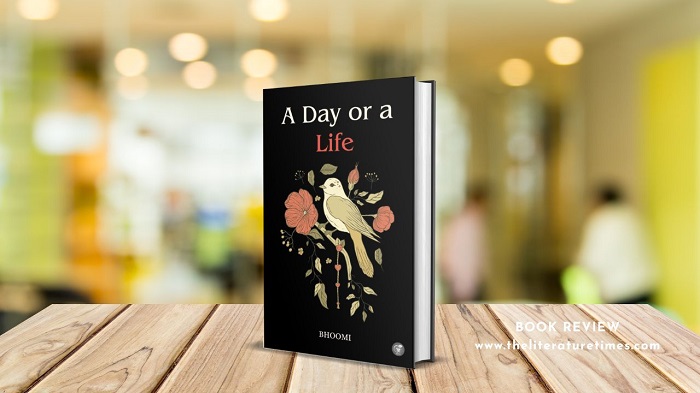
In literature, there are stories that sweep us away with grand adventures, and then there are stories that quietly sit with us, holding a mirror to our own unspoken emotions. A Day or a Life by Bhoomi belongs to the latter category—a book that doesn’t shout for attention, but whispers truths that linger long after the last page.
At the heart of the story is a girl who, by chance, encounters an injured baby bird on her hostel campus. Its fragile body and broken wings immediately ignite a conflict within her: should she let her proclaimed indifference win, or should she allow herself to feel the pull of compassion? What follows is a long, restless night that becomes a turning point—not only for the bird’s fragile life but for the girl’s buried emotions.
The narrative delicately balances storytelling with reflection. Bhoomi’s writing does not merely describe events; it explores the emotional tremors beneath them. Each moment of care—the offering of water, the sheltering of the fragile creature, the silent prayers—becomes layered with meaning. The girl’s struggle between detachment and empathy mirrors a universal human conflict: the fear of vulnerability versus the desire to connect.
What makes this book so powerful is its ability to take something as small as caring for an injured bird and expand it into a philosophical exploration of life. The bird is not just a bird—it becomes a metaphor for fragility, resilience, and the parts of ourselves we often ignore. In saving another life, even briefly, the girl is forced to confront her own hidden griefs and unacknowledged capacity to care.
Bhoomi’s prose is simple yet piercing. She avoids over-dramatization, instead weaving intimacy through quiet observations and internal dialogue. The reader is invited into the protagonist’s mind, where silence is just as important as words. The atmosphere she creates—dim hostel rooms, sleepless hours, hushed thoughts—draws us into the vulnerability of the moment.
As a debut, A Day or a Life is remarkable in its maturity. Bhoomi writes with the sensitivity of someone who has spent a long time listening to life rather than rushing through it. Her ability to translate those silent observations into words is what sets this book apart. The story may revolve around a single night, but its echoes expand into broader questions: What does it mean to care? How do we face loss? And how often do we let fleeting encounters redefine who we are?
The emotional core of the book is empathy—how it sneaks into the quietest corners of our lives, challenging the walls we build around ourselves. It is also about resilience: of the bird, of the girl, and of anyone who has ever chosen to keep caring despite the inevitability of pain.
In the end, A Day or a Life is not just about one night or one fragile bird—it is about the moments that change us without warning. Bhoomi has crafted a debut that is thoughtful, tender, and deeply human. This is a book that readers of reflective, emotionally rich literature will treasure.