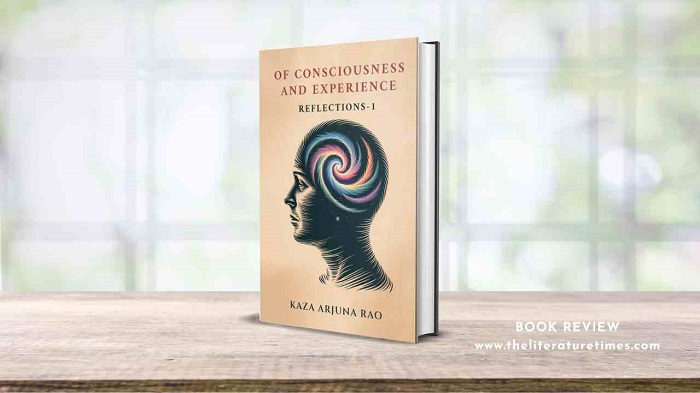
Title: Of Consciousness and Experience: Reflections – 1
Author: Kaza Arjuna Rao
Publisher: Astitva Prakashan, 2025
Kaza Arjuna Rao’s Of Consciousness and Experience: Reflections – 1 is a contemplative odyssey through the dimensions of existence — from the genesis of the cosmos to the intricacies of the human mind. The book is not merely a philosophical treatise but a synthesis of spiritual insight, intellectual inquiry, and social reflection. Divided into twelve chapters, it traverses a wide spectrum of themes such as theology, psychology, paraphysics, philosophy, sociology, and the future of consciousness. The author’s approach is not academic but experiential, inviting readers into a deeply introspective engagement with the self and the universe.
The work opens with “A New Beginning,” where Rao sets the tone for his exploration — emphasizing that human progress is incomplete without inner evolution. He notes that while humanity has advanced technologically, it has regressed morally and spiritually. The “new beginning” he envisions is not external reform but inner awakening — a balance between action and reflection, intellect and wisdom, technology and morality. This theme echoes throughout the book and becomes the ethical compass for the entire narrative.
In “Genesis,” Rao reimagines human evolution as a spiritual process rather than a purely biological one. He traces mankind’s journey from superstition to philosophy, suggesting that our search for meaning stems from an ancient yearning to reunite with the divine. The chapter skillfully connects mythology, metaphysics, and moral philosophy into a single continuum — portraying creation as both cosmic and personal.
“Theology” and “God and Religion” together form the philosophical heart of the book. Rao distinguishes between the Creator and God — the former being formless and beyond comprehension, while the latter represents humanity’s evolving ideal of the divine. His critique of organized religion is sharp yet compassionate; he observes how theology, once a quest for truth, has become an instrument of institutional control. Through these reflections, Rao challenges readers to rediscover the divine not as a distant entity but as the highest form of consciousness within themselves.
The discussion reaches a fascinating height in “Paraphysics,” a chapter that ventures beyond conventional science into the metaphysical domains of existence. Here, Rao blends ancient spirituality with modern theoretical insight, proposing that consciousness precedes matter. He describes paraphysics as the study of unseen forces that influence life and thought — bridging physics, metaphysics, and spirituality. His analogy of the soul evolving into spirit and eventually into God provides an innovative philosophical model of consciousness evolution.
Chapters like “Philosophy,” “Psychology,” and “Sociology” bring the discussion from the metaphysical to the moral and social. Rao laments the decline of ethics in the modern age — where philosophy is reduced to intellectual debate and psychology to behavioral control. He argues that true philosophy should awaken conscience and that psychology must reconnect with the soul. His sociological analysis, meanwhile, exposes the moral contradictions of modern civilization — the widening gap between material abundance and inner poverty. The critique of economic inequality and spiritual hollowness is particularly striking, reminding readers that a society without ethics is a civilization on the verge of collapse.
The later chapters — “Human and Society,” “Society and Economics,” and “The Future of Consciousness” — serve as both diagnosis and prescription. Rao envisions a new civilization grounded in moral clarity and inner balance. He foresees a future where education nurtures not only intellect but conscience, and where technology serves human values rather than enslaving them. The book culminates in a profound insight: the survival of humanity depends not on technical mastery but on an awakening of consciousness.
Stylistically, the prose is meditative, eloquent, and accessible despite its philosophical density. Each sentence invites reflection, each idea unfolds into another, creating a seamless tapestry of thought. What makes the book exceptional is its integration of Eastern wisdom and universal humanism. Rao’s reflections resonate with the Upanishadic spirit, yet they address the modern reader’s existential concerns — alienation, moral decay, and the loss of meaning.
Of Consciousness and Experience is not a book to be read in haste; it demands contemplation. Its relevance lies not just in what it explains, but in what it awakens — the realization that consciousness is the true frontier of evolution. In an age obsessed with information, Rao’s work stands as a call to wisdom, reminding us that knowledge without self-awareness is emptiness.