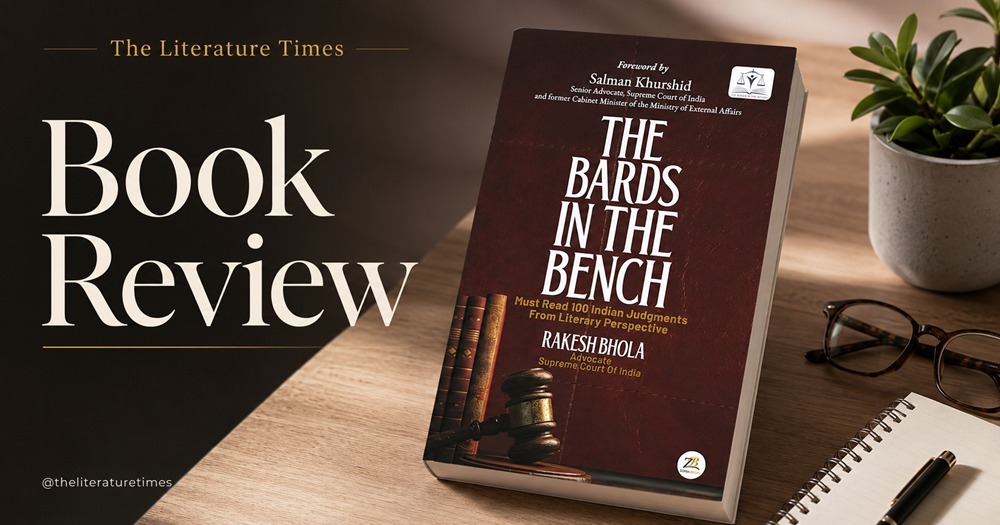
Platform: The Literature Times
In The Bards In The Bench, Rakesh Bhola turns attention to a dimension of judicial writing that is often noticed in passing but rarely examined with sustained seriousness: the presence and purpose of literary references in legal judgments. The book explores one hundred seminal judgments of Indian courts and considers how literature, language, and cultural memory enter judicial reasoning, not as ornamental additions but as devices capable of clarifying ideas, sharpening moral questions, and giving legal expression a wider human resonance. Bhola’s project is especially interesting because it comes from a writer who is also a practicing advocate and a member of the Supreme Court Bar Association. That dual engagement with law and literature gives the book a natural intellectual foundation. Rather than treating the two fields as separate worlds, he approaches them as traditions that frequently meet at the level of interpretation, persuasion, ethical reflection, and the search for meaning.
The central strength of the book lies in the subject it chooses to foreground. Legal judgments are commonly read for holdings, precedents, constitutional principles, procedural directions, and doctrinal developments. Yet many important judgments also carry a distinctive literary quality. Judges sometimes draw upon poetry, fiction, philosophy, drama, aphorism, and other forms of cultural expression to frame questions that law alone may describe inadequately. The Bards In The Bench invites readers to look closely at this phenomenon. By gathering literary references from a substantial body of judicial writing and placing them within an interpretive framework, Bhola encourages a richer understanding of what judicial language can do. A judgment is not merely a technical instrument; at its best, it can also be a carefully crafted public text that explains the demands of justice to society. Literature can help make that explanation memorable, humane, and intellectually expansive
This focus gives the book relevance beyond the immediate community of lawyers. Students of literature may find in it an unusual afterlife of literary expression, where familiar modes of thought move from books and poems into the reasoning of courts. Law students and young advocates, on the other hand, may discover that precision and imagination are not necessarily opposing qualities. The disciplined use of language can accommodate both analytical rigor and evocative expression. For general readers interested in public institutions, the book also offers a window into how judges communicate difficult issues in terms that connect abstract principles with wider social and cultural experience. Bhola’s selection of excerpts and accompanying commentary, as described, is therefore not simply a catalogue of quotations. Its value lies in showing why such references matter and how they can deepen the texture of judicial discourse.
The book’s approach is particularly suited to its theme. Rather than making a broad theoretical claim about the relationship between law and literature and leaving it at that, Bhola anchors the discussion in actual judicial writing. The choice to examine one hundred seminal judgments gives the work both breadth and a strong documentary quality. It allows readers to encounter the intersection of law and literature repeatedly, across different legal contexts, and to recognize that literary expression within judgments is not an isolated curiosity. The format also makes the subject approachable. Readers do not need to begin with an advanced academic background in law-and-literature studies in order to appreciate the central idea: that language shapes the way institutions reason, explain, persuade, and remember. By focusing on specific references and their significance, the book can serve as a bridge between specialist legal reading and broader literary inquiry.
Bhola’s own background is clearly relevant to the sensibility behind this work. His early exposure to multilingual writing through his father, his education in English Literature, his experience as an editor and university press reporter, his period teaching English at the college level, and his later legal practice together form an unusual but coherent trajectory. His continued involvement with poetry, reflective essays, book reviews, and both legal and literary books helps explain why this subject would attract him. The Bards In The Bench appears to emerge from that long-standing overlap in his intellectual life: the advocate attentive to judicial reasoning and the literary reader alert to voice, reference, rhythm, metaphor, and cultural inheritance. That combination gives the project credibility because the topic is not being approached as an external curiosity; it grows organically from the author’s established engagement with both disciplines.
Another important contribution of the book is its implicit argument about the public character of legal language. Courts deal with questions that affect liberty, dignity, power, rights, institutions, and social relationships. Technical accuracy is indispensable, but legal decisions also exist in a society whose understanding of justice is shaped by stories, history, moral language, and collective memory. Literary references can provide a vocabulary through which difficult principles become more accessible or emotionally intelligible. Used well, they can help a judgment communicate not only what the law says but why a legal issue carries human significance. Bhola’s commentary on such moments encourages readers to think about judicial writing as a form of civic communication. This is an especially valuable perspective in an era when legal decisions are increasingly read outside courtrooms by journalists, students, citizens, researchers, and readers with no formal legal training.
The book also raises productive questions about balance. Literary expression in law must serve thought rather than distract from it, and elegance cannot substitute for sound legal reasoning. That tension makes Bhola’s subject more than a celebration of beautiful writing. The real interest lies in examining how a reference functions within a judicial text: whether it clarifies, contextualizes, humanizes, or intensifies an argument. By highlighting the relevance of literary references rather than treating them as decorative flourishes, The Bards In The Bench points readers toward a more disciplined appreciation of style. The book’s strongest potential value is therefore analytical as much as aesthetic. It can encourage lawyers to read judgments more attentively, students to notice the craft of legal prose, and literary readers to observe how cultural texts acquire new meanings when invoked in institutions of law.
As a reading experience, the subject promises variety because it brings together two traditions with different habits of expression. Law seeks order, definition, precedent, and reasoned application; literature often thrives on ambiguity, metaphor, perspective, and emotional complexity. The productive friction between them is precisely what makes the book compelling. Bhola’s work suggests that judicial writing can benefit from the expressive resources of literature without surrendering legal discipline. That idea gives the collection an intellectual coherence beyond the individual excerpts. It becomes a study of how one form of writing can illuminate another, and how legal discourse may gain depth when it acknowledges the broader traditions of thought and language from which judges, lawyers, and citizens inevitably draw.
The Bards In The Bench should appeal most strongly to advocates, judges, law students, researchers, teachers, and readers interested in the humanities, but its reach need not stop there. Anyone curious about how institutions use language to frame questions of justice can find value in its central premise. Its subject is specialized, yet the questions it raises are broadly human: How do we explain fairness? How does language influence authority? What happens when legal reasoning meets poetry, philosophy, and narrative imagination? By assembling and interpreting literary moments from Indian judicial writing, Rakesh Bhola offers readers a distinctive way to approach these questions. The book stands out not because it tries to make law literary, but because it reveals how literary consciousness has already entered the language of law—and why that presence deserves thoughtful attention.