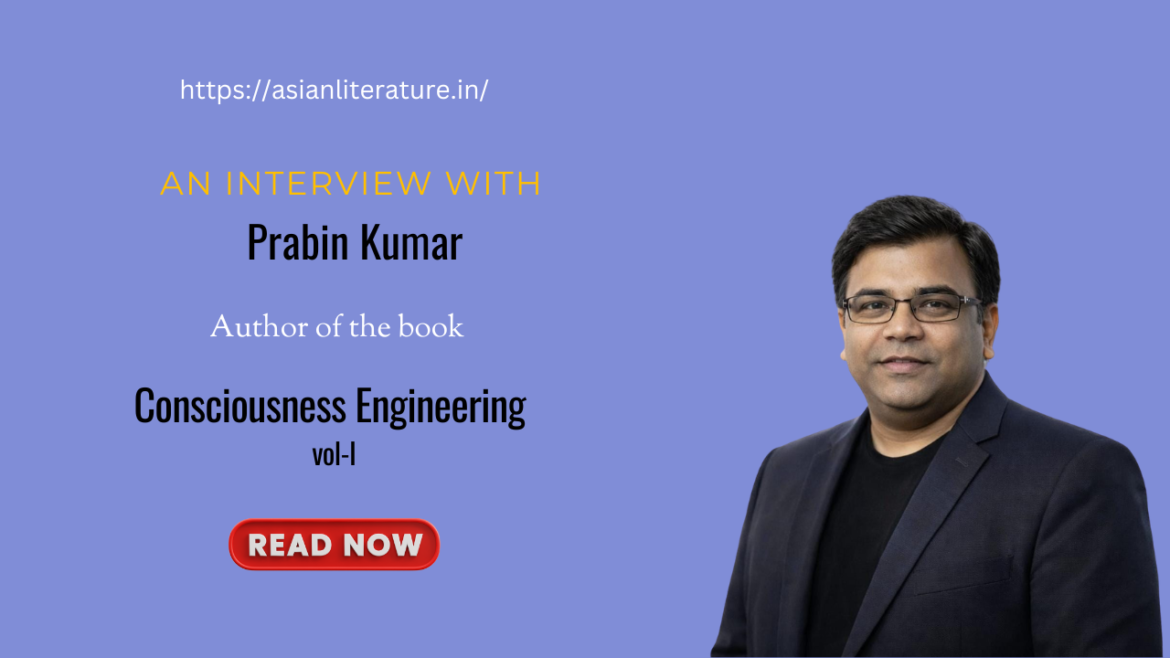
Title: Consciousness Engineering vol-I
Author: Prabin Kumar
ISBN: 978-93-4726-312-5
Publisher: Inksight Publishers
About the Book:
This Book will give theoretical scientific Concept about consciousness, Importance, Usefullness and application of its. This Book will teach How it is and can effect human life and its growth. This Book will give theoretical concept in scientific and spiritual way about consciousness its application, Its, effect and How its build, grow, Preserve and many more.
About the Author:
Author is Regd. Project Investigator by DST, Govt of India, Contributor and Member in ECPR and Its steering committee, un-wmo. Having Multi dimensional research paper and patent filed under Indian Patent act. Author having research in computational science which available on GIthub for citation and Use for researcher and student.
Neel Preet: What inspired you to write Consciousness Engineering Vol.-I, and what questions about consciousness were you hoping to address?
Prabin Kumar: The inspiration came from a simple observation: despite extraordinary advances in physics, neuroscience, psychology, and artificial intelligence, consciousness remains one of the least understood aspects of reality. My goal was not to provide a final answer, but to explore whether consciousness could be approached through a unified framework integrating science, systems theory, and philosophy.
Neel Preet: Your book introduces the Node–Wave Framework and challenges the traditional view that the brain generates consciousness. What led you to explore this alternative perspective?
Prabin Kumar: The Node–Wave Framework emerged from the observation that neuroscience explains many correlates of consciousness, yet the hard problem remains unresolved. I explored whether the brain may function as an interface, organizer, or transducer of conscious processes rather than solely a generator.
Neel Preet: You describe the brain as an interface rather than a generator of consciousness. How does this idea change our understanding?
Prabin Kumar: It expands inquiry beyond neural activity alone and encourages investigation of information integration, self-modeling, embodiment, and environmental interaction as contributors to conscious experience.
Neel Preet: How did you develop neural existence, temporal coherence, and recurrent feedback into a unified framework?
Prabin Kumar: I noticed that stable systems across biology, computation, and society depend on continuity, integration, and feedback. These principles were combined to explain how stable conscious experience may emerge from dynamic processes.
Neel Preet: Why is the observer so important in your model of reality?
Prabin Kumar: Any scientific measurement becomes meaningful only when it is observed and interpreted. Consciousness is unique because it is both the subject being studied and the instrument through which study occurs.
Neel Preet: What transforms information into awareness?
Prabin Kumar: Information processing alone does not explain subjective experience. I explore whether recursive self-modeling, integration, temporal continuity, and embodiment together contribute to awareness.
Neel Preet: How do self-models, identity, and continuity explain our sense of self?
Prabin Kumar: The self appears to emerge from continuity. Memory, feedback, and self-modeling create the impression of a stable identity persisting through time.
Neel Preet: Could machines ever become truly conscious?
Prabin Kumar: I remain open to the possibility, but current AI systems do not meet the necessary conditions. My NBI hypothesis suggests consciousness may require energy-regulated, embodied, recursively self-modeling systems.
Neel Preet: How do you respond to critics who see consciousness as purely neural activity?
Prabin Kumar: Criticism is essential. Neuroscience has achieved remarkable success, but it may not yet provide a complete explanation. Alternative frameworks should be evaluated through consistency, explanatory power, and testability.
Neel Preet: What key insight would you like readers to take away?
Prabin Kumar: Consciousness deserves to be studied with the same seriousness as matter, energy, life, and information. I hope readers approach it as a frontier for exploration rather than a mystery beyond investigation.