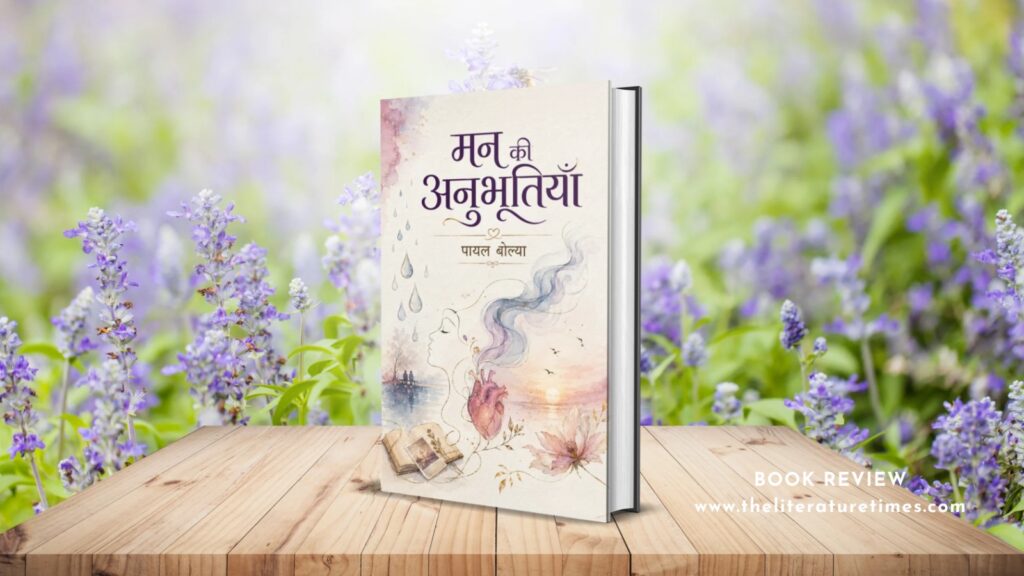
Man ki Anubhutiyan by Payal Bolya is presented as a poetry collection rooted in the emotional textures of everyday life. Its stated purpose is simple but demanding: to take feelings that are often difficult to explain and give them a form that readers can recognize as their own. The book moves through joy, enthusiasm, belonging, surprise, pain, tears, and the quiet ache that can remain hidden even in ordinary moments. Rather than treating emotion as a single dramatic event, the collection frames it as a continuing presence in human experience. That approach gives the book an immediately relatable foundation and positions it as poetry meant to be felt personally rather than approached only as an exercise in literary technique.
The central theme of the collection is emotional connection. The description repeatedly emphasizes that each poem carries a sense of belonging and an unspoken feeling, suggesting a body of work concerned with what exists beneath everyday language. This is important because much of human experience is not easily organized into neat explanations. Affection can sit beside disappointment; excitement can coexist with anxiety; memory can contain both warmth and hurt. Man ki Anubhutiyan appears to embrace this complexity rather than resolve it. Its value lies in making space for contradictory states and allowing readers to encounter emotion in a form that feels intimate, recognizable, and open to personal interpretation.
Another notable aspect is the relationship between imagination and lived experience. The book is described as bringing together imagined ideas and experiences in a way that can resonate broadly. That balance can be especially effective in poetry, where literal autobiography is not necessary for emotional truth. A feeling may begin in a personal moment and still become meaningful to someone with a very different life. By focusing on shared inner responses rather than highly specific external events, the collection has the potential to create a bridge between poet and reader. Its emotional language is intended not merely to tell the reader what the poet felt, but to awaken a parallel feeling, memory, or association within the reader.
The book’s emotional range is also one of its strongest stated qualities. It does not confine itself to sadness, romance, optimism, or reflection alone. Instead, it moves across excitement and enthusiasm, tears and hidden pain, waves of joy, rain-like freshness, and moments of belonging. This variety matters because it mirrors the irregular rhythm of real life. A reader may not come to poetry looking for one fixed mood; often, the appeal lies in finding different emotional doors across different pages. Man ki Anubhutiyan seems designed for that kind of reading experience, where one poem may comfort, another may unsettle, and another may simply remind the reader of something personally meaningful.
Payal Bolya’s background, as supplied with the book, helps clarify the collection’s creative impulse without becoming a substitute for the poetry itself. Her interest in writing began at a young age and developed into a sustained passion for poetry, even as she completed her graduation in commerce. She is described as someone who turns small details and subtle feelings into poetic expression. That orientation is well suited to a collection centered on internal experience. Poetry often becomes most accessible when it notices what people normally pass over: a fleeting reaction, a small memory, a familiar emotional tension, or the private meaning attached to an ordinary moment. The book’s stated focus suggests a writer attentive to precisely those details.
For readers, the most meaningful strength of Man ki Anubhutiyan may be its invitation to participation. The book is not presented as a collection that asks readers to admire distance, complexity, or abstraction. Instead, it aims to create personal recognition. The recurring idea that a voice from one heart can reach another gives the collection a clear reader-centered philosophy. In practical terms, that makes the book suitable for readers who turn to poetry for companionship, reflection, and emotional articulation. It may also appeal to those who do not consider themselves regular poetry readers but value writing that can express feelings they have experienced without always having the words to describe them.
The collection is relevant in a broader sense because contemporary life often encourages speed while emotional understanding requires attention. A book built around inner experiences can function as a pause: not an escape from reality, but a slower way of noticing it. Feelings of belonging, joy, pain, and surprise are universal, yet each person experiences them differently. Poetry can hold that difference without forcing a single interpretation. Man ki Anubhutiyan therefore offers value not by claiming to provide answers, but by giving readers room to identify, remember, and reflect. Its emphasis on shared feeling also reinforces the idea that private emotions need not remain isolating; they can become points of connection when expressed with sincerity.
The book’s intended audience is consequently broad but identifiable. It should speak most directly to readers who enjoy emotionally driven poetry, reflective writing, and work concerned with the inner life. Readers who appreciate accessible themes of memory, attachment, joy, hurt, and personal connection are likely to find the collection approachable. It can also be meaningful for younger readers discovering poetry as a language for self-expression, as well as adults who return to poems during periods of reflection. Because the supplied description stresses connection over technical display, the book’s appeal rests on emotional immediacy and resonance rather than on specialized literary knowledge.
As a literary offering, Man ki Anubhutiyan is most compelling in the clarity of its purpose: to transform personal feeling into shared emotional recognition. The collection promises neither a single mood nor an artificial positivity. It acknowledges that the heart can carry enthusiasm and pain at the same time, and that a reader may encounter joy, surprise, tenderness, or ache from one poem to the next. That emotional openness gives the book its reader value. For anyone who sees poetry as a conversation between inner worlds, Payal Bolya’s collection offers an inviting premise – one in which imagination and experience meet, private feeling becomes communicable, and the distance between the writer’s heart and the reader’s own can become a little smaller.
Rating : 4.8 / 5




Your perspective matters
Share your thoughts respectfully. Comments are moderated.