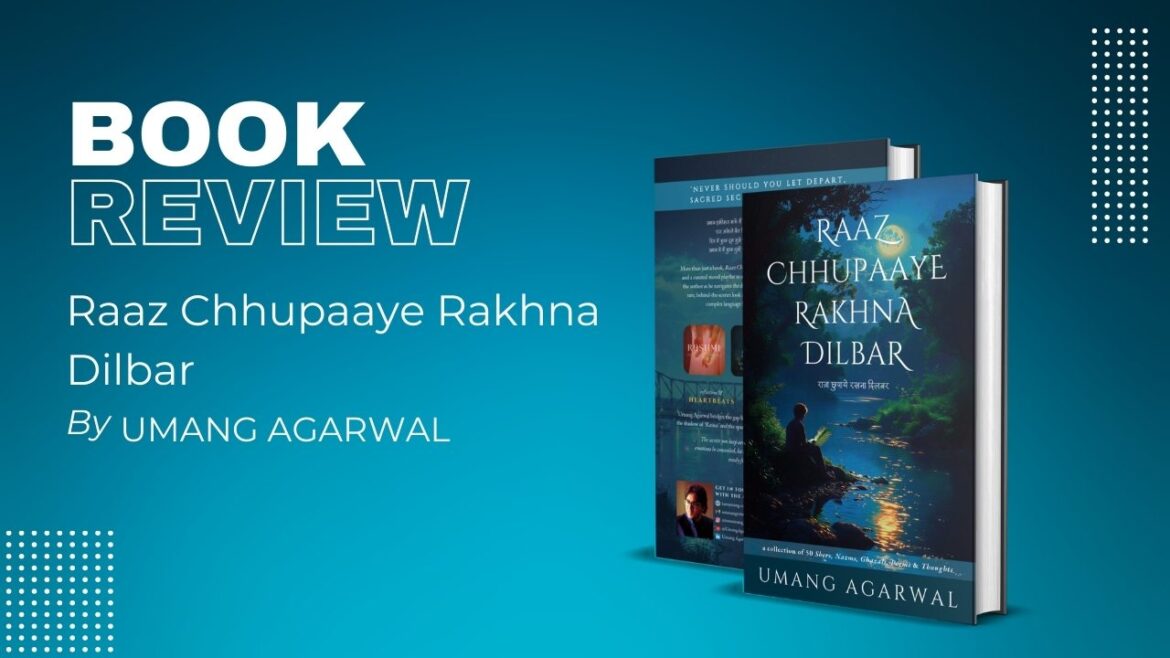
Title: Raaz Chhupaaye Rakhna Dilbar
Author: UMANG AGARWAL
ISBN: 9789373357829
Publisher: Evincepub Publishing
The Book and the Person Behind It
Some books arrive at your doorstep and knock loudly. Some just slip quietly under the door and wait. Raaz Chhupaaye Rakhna Dilbar is the second kind. It does not announce itself with drama. It does not perform its sadness. It simply sits down beside you, patient and unhurried, like a secret that has been sitting in someone’s chest for five full years, waiting for exactly the right moment to finally be let out.
Umang Agarwal, born in Kolkata in 2003, is simultaneously a law student, a film director, a music composer, a lyricist, and now a published poet. That combination should logically produce confusion. Strangely, it produces extraordinary clarity. Because when someone lives in so many worlds at once, they learn very quickly that feelings do not wait for convenient moments. They arrive at 3 am and demand to be written down. This entire collection is the result of that exact truth.
The book was blessed in spirit by Padma Bhushan Javed Akhtar Sahib — not through a formal association, but through a genuinely charming encounter described in the opening pages under the title An August Occasion. The author walked into the green room of an event, sat beside one of India’s greatest lyricists, listened to him play Desh Ki Mitti on his phone, and asked, with all the nerve that only a true lover of poetry could have, the difference between a Ghazal and a Sher. That one question apparently changed how the author thought about his own craft. The shift is visible throughout the book.
Raina — Where the Book Truly Begins
Thirty pieces. Thirty nights. That is exactly what this first chapter feels like. Named after the word for night, the author opens it with a quote from Gulzar Sahab about sleeplessness, which is precisely the right way to enter a room like this one. The dominant emotion throughout Raina is not the theatrical heartbreak of films. It is the quiet, grinding kind — the kind where you check your phone for no reason, where you think of someone while doing completely ordinary things.
Puch liya ghar baar hamaara, puch liya number aur kaam,
Par na puche koi yahaan pe — kya dil ko kuch hai aaraam?
— Aaraam (Chapter I — Raina)
These two lines from Aaraam (Rest) open the chapter and set the entire emotional frequency of the book. Everyone asks about your house, your job, your number. Nobody asks about the state of your heart. It is a small question but it hits hard because it is completely, quietly true. Bahaane (Excuses) is another piece deserving special attention — a Ghazal about how a dying relationship takes every form of expression with it: no tears, no songs, no shayari, not even bitter sarcasm. Only excuses for separation remain. The imagery of forgetting a sacred verse the way one forgets an excuse is genuinely startling.
The chapter also has more playful, conversational pieces like Jaao Humne Maan Liya (Fine, We Accept!) and Kyun Sapnon Mein Aate Ho (Why Do You Come in My Dreams?), which give the chapter a breathing space between the heavier pieces. By the time you reach Zaruri Nahi Hai — a proper Ghazal circling through all the things love does not require of you — the chapter feels complete. Like a long, sleepless night that finally, quietly turned into morning.
Dashamlav — The World Outside the Heart
If Raina is about the interior world, Dashamlav is about the exterior one. Named after the decimal point — the small thing between two numbers that changes everything — this chapter moves from personal heartbreak into something wider and darker: hypocrisy, inequality, religion reduced to reward, childhood lost too soon. The author’s range opens up here and so does his wit.
Calculator is a poem about divine accounting on Judgment Day. God arrives with a calculator, and the math does not work in the person’s favour. It is part-comic and part-chilling, and entirely effective. Puchta Hai (He Asks) takes a sharp look at performative religion — people who visit places of worship not for devotion but for outcomes, for rewards. It ends with the beautiful irony of God Himself demanding to know who is to blame for all of this.
Jaisi sabki maa hoti hai,
Waisi hi anmol hai syaahi!
— Syaahi / Ink (Chapter II — Dashamlav)
But the piece that will stay with you longest is Sunn Re Bachpan (Listen, O Childhood). Written in a folk dialect, it speaks directly to one’s lost childhood, asking it to be patient, saying it will return. The line ‘raat akele bina aasra, kaas tanik tum hote paas’ — alone at night, without any shelter, I only wished you were near — lands with a weight that prose cannot explain. And Syaahi (Ink), which closes this chapter, turns the act of writing itself into a meditation. Ink is compared to a mother: priceless, irreplaceable, present in every moment of a writer’s life. It is a deeply personal note to close an otherwise outward-looking chapter.
Jheeni — The Chapter That Whispers
Here the book lowers its voice to nearly a whisper. Jheeni means subtle, fine, delicate — and every piece in this chapter earns that word. These are short Rubaaiyaan, four-line thoughts, that do not explain themselves. They hand you an image and step back. You are expected to do the rest.
Dil is exactly two lines: the heart weighs every relationship in emotions, beats plenty, but says nothing. Kaash imagines a love without identity or name, where even though the heart breaks, neither person is present to witness it. And Shor (Noise) — the last piece of the chapter — may be the single most devastating thing in the entire book.
Sunn zara dhadkan mere tu, ishq na karna kabhi,
Log teri dhadkanon ko, shor na samjhein kahin…
— Shor / Noise (Chapter III — Jheeni)
In four lines, it captures what it means to love in a world that does not speak your language — a world that would mistake the very sound of your heartbeat for mere noise. This chapter is the shortest in the book. It is also the one you will return to the most. When the world is too loud and the right words are nowhere, Jheeni will be there — quiet, precise, and enough.
Aagaaz — A Lyricist’s Confession
This is the most unexpected chapter in the book and perhaps the most valuable one for anyone who loves Hindi film music and the craft behind it. The author steps completely back from poetry and takes you inside the writing of his debut song Reshmi — a song about one-sided love, told from the female perspective, released in 2025.
What follows is part lyrical breakdown, part film-studies essay, part personal confession. He explains why the song begins with the word Reshmi — silk — because a girl confessing love for the first time speaks like she is running out of breath, out of words, as soft as the material itself. He explains why the hook line ‘Ya ke tum mere ho, ya hun main tumhaari’ (Either you are mine, or I am yours) is not compromise but surrender — because true one-sided love never demands to be accepted. It simply gives.
He quotes Javed Akhtar’s narration from Dil Dhadakne Do, Jaideep Sahni’s beautiful lines from a Sonu Nigam song, and references old Bollywood duet culture with genuine affection and deep knowledge. None of this feels like name-dropping. It reads like a young writer talking about his teachers with tremendous respect. The chapter also includes unreleased lyrics — lines too heavy for the final song but too honest to discard. He publishes them as they are, incomplete by intention, with the note: ‘Let every line decide its own fate.’
A Debut That Breathes
Raaz Chhupaaye Rakhna Dilbar is not trying to be the next great work of Urdu literature. It knows exactly what it is: five years of honest feeling, arranged with care, offered to anyone willing to receive it. There are pieces here that are polished and technically precise — Ghazals that follow their form with real understanding, Rubaaiyaan that trust the reader completely. And there are pieces still finding their footing. But that process of finding is visible in the writing, and it gives the collection a live, breathing quality that over-polished debut poetry sometimes loses entirely.
What does not waver, from the first page to the last, is the sincerity. This author is not performing sadness or performing depth. He is genuinely present in every late night, every unanswered feeling, every line that refuses to explain itself. That quality is rarer than technical skill and far harder to teach or imitate.
Read it slowly. Read it at night. Use the Mood Playlist the author has curated inside the book. And when you reach Shor, or Sunn Re Bachpan, or the last paragraph of Aagaaz — allow yourself a moment before turning away. Some books deserve that pause. This one has earned it.
Review by Sameer GudhateFor www.theliteraturetimes.com