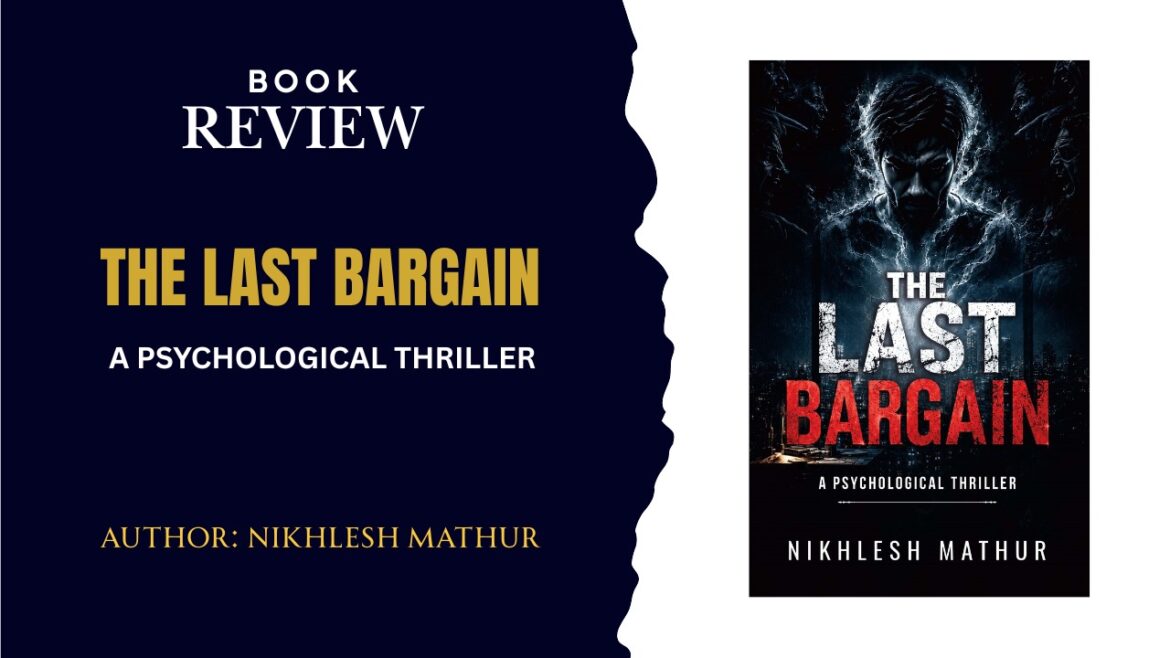
Title: The Last Bargain
Author: Nikhlesh Mathur
Publisher: Evincepub Publishing
There is something inherently unsettling about discovering that the person you have always believed yourself to be may not be the whole truth. Nikhlesh Mathur builds The Last Bargain around precisely that fear. What begins as the story of an insecure, frequently humiliated man gradually develops into a strange and increasingly dangerous tale involving unexplained violence, scientific experimentation, political influence, murder and the disturbing possibility that human consciousness may be capable of operating beyond the physical body.
At the centre of the novel is VK, a man who has spent much of his life being treated as weak. He is mocked by colleagues, bullied by Mahendra, belittled by his superior Rana and constantly reminded of his limitations. His marriage to Sareeta is equally complicated. There is affection between them, but there is also frustration, disappointment and a pattern of remarks that continually damage VK’s already fragile sense of masculinity and self-worth.
This emotional foundation is important because Mathur does not introduce VK as a conventional thriller hero. He is not brave, physically powerful or naturally decisive. In fact, his inability to defend himself is one of the defining features of his personality.
Then something impossible happens.
One night, VK confronts Mahendra and beats the much stronger man with astonishing ease. The following morning, however, circumstances suggest that VK had apparently been sleeping at home. The contradiction becomes the novel’s first major hook. VK himself cannot decide whether what he remembers was a dream or reality, even though Mahendra insists that VK was the man who attacked him.
From this point, The Last Bargain repeatedly plays with the question of identity. What happens when a powerless man suddenly develops access to a version of himself that can accomplish everything his conscious personality is afraid to do?
The idea becomes more disturbing as similar incidents begin to accumulate. Actions seem to take place while VK’s physical body is elsewhere. People connected to his humiliation and anger become victims of unexplained events. Police officers investigating the deaths find motive but struggle with opportunity. In one particularly effective development, investigators note that individuals with conflicts involving VK have died under mysterious circumstances even when VK apparently could not physically have reached them.
The novel does not remain entirely within supernatural territory. Mathur introduces scientist Rajshekaran and takes the story into the world of clandestine biological experimentation. VK becomes involved in human trials without fully understanding their implications. Rajshekaran’s laboratory, secretive procedures and experimental compound introduce a science-thriller dimension to the narrative. VK is eventually identified as Subject 009 in a series of experiments in which earlier subjects have either died or become unstable. The experiments appear to affect the nervous system and create a dissociative condition in which a part of consciousness may operate independently of the body.
That explanation is one of the more interesting choices in the book because it deliberately keeps the reader between science and the supernatural. Is VK experiencing an extreme biological phenomenon, something spiritual, or an event that science can describe without truly explaining?
Mathur also broadens the story beyond VK’s private crisis. The experimental programme has connections to money, powerful individuals and political protection. The character of Sahebji brings institutional corruption into the narrative, making the danger larger than one scientist performing questionable experiments. The later chapters reveal how inconvenient truths can be controlled, investigations influenced and public narratives manufactured when powerful people have enough at stake. The manuscript even shows evidence surrounding Rajshekaran being concealed while political interests continue to operate behind the scenes.
Among the supporting characters, Sareeta deserves particular attention. She can initially appear harsh because her teasing frequently wounds VK, but she becomes more emotionally complex as events intensify. Her relationship with VK evolves alongside the thriller. Ruhani, meanwhile, is much more than the object of VK’s attraction. Her investigation into Rajshekaran’s activities eventually gives her an important role in uncovering the truth behind the experiments.
The novel’s strongest quality is its willingness to combine genres. There are elements of domestic drama, crime investigation, psychological suspense, scientific conspiracy, political intrigue and paranormal fiction. At times, this makes the narrative deliberately unpredictable. A seemingly ordinary office rivalry may connect to a murder investigation; marital insecurity may influence an act of revenge; and an experimental drug may open questions that sound closer to metaphysics than medicine.
The title The Last Bargain becomes increasingly appropriate as VK discovers that the power he once wished for carries consequences he never imagined. His transformation raises the novel’s central moral question: if a person who has endured humiliation suddenly gains the ability to punish everyone who wronged him, does that power liberate him—or destroy the person he once was?
Mathur does not offer an entirely comfortable distinction between victim and perpetrator. VK earns the reader’s sympathy because his humiliation is genuine, yet his growing appetite for retaliation becomes frightening. At one stage, he recognises that he has become something worse than the people he once hated.
That moral uneasiness gives the novel greater weight than a straightforward revenge thriller.
The Last Bargain is ultimately a story about suppressed anger, wounded identity and the dangerous seduction of power. Readers who enjoy thrillers that mix crime, unusual scientific ideas and supernatural ambiguity will find plenty to engage with here. It asks an intriguing question long after the mystery begins to unfold: when the weakest part of you finally learns how to fight back, can you still control what it becomes?
Buy on Amazon : https://www.amazon.in/Last-Bargain-Nikhlesh-Mathur/dp/9373354108